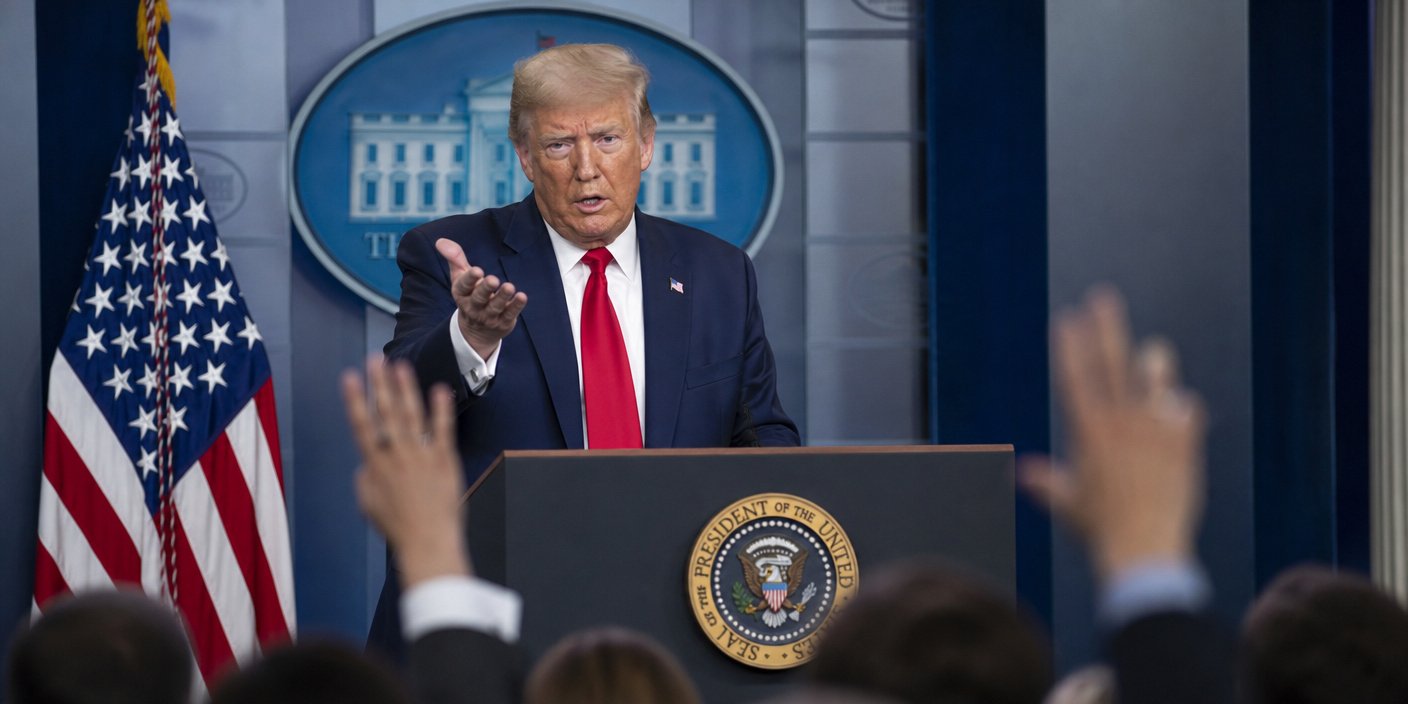

In a decisive pivot against the growing chorus of tech industry leaders calling for a global pause on advanced artificial intelligence development, former President Donald Trump has reaffirmed his commitment to an unbridled AI innovation agenda. Trump’s position, characterized by a ‘whoever wins AI wins’ doctrine, views the rapid advancement of machine intelligence not merely as a commercial opportunity, but as a critical, non-negotiable strategic race against China. By explicitly rejecting the implementation of government-imposed guardrails—a stance championed by various Silicon Valley safety advocates and industry insiders—Trump is positioning American AI development as a cornerstone of future national security and economic supremacy.
Key Highlights
- The ‘Win at All Costs’ Doctrine: Trump explicitly rejects the concept of a development moratorium, viewing it as a strategic disadvantage that would cede global dominance to adversaries.
- Geopolitical Stakes: The policy centers on the premise that AI is the modern-day ‘arms race,’ with China identified as the primary competitor in the race for technological supremacy.
- Regulatory Philosophy: The approach prioritizes deregulation, arguing that heavy-handed oversight creates a ‘regulatory chill’ that stifles American ingenuity while providing a vacuum for international rivals to exploit.
- Divergence from Industry Leaders: This strategy directly clashes with influential figures like Sam Altman and Elon Musk, who have previously advocated for international regulatory frameworks and pauses to address potential existential risks.
The Geopolitical Imperative: Why the US Refuses to Brake
The central tension in the current AI discourse is between risk-aversion and rapid-deployment. While safety advocates within the private sector have pushed for the establishment of international oversight bodies and testing requirements to mitigate risks of advanced models, the Trump administration’s approach remains rooted in the concept of competitive advantage. The logic is straightforward: in the realm of advanced intelligence, the first nation to achieve broad capabilities will effectively dictate the global standard for the technology.
The ‘Winner-Take-All’ AI Mandate
For the former President, the trajectory of artificial intelligence is fundamentally a zero-sum game. This echoes the sentiment found in his earlier administration, specifically Executive Order 13859, the ‘American AI Initiative’ launched in 2019, which directed federal agencies to prioritize AI research and development. The current rhetoric, however, has intensified. Rather than viewing AI development as a collaborative international process, the narrative has shifted to frame the technology as a decisive theater for 21st-century power. This means that any ‘pause’ or ‘slowdown’ initiated by Western firms would not stop the development of global AI capabilities; instead, it would merely provide a strategic opening for competitors, namely China, to bridge the current American lead in compute power and algorithmic sophistication.
Countering the Beijing Model
China has made no secret of its ambition to become the world’s leading AI superpower by 2030, a goal bolstered by the government’s ‘Made in China 2025’ initiative and its heavy investment in state-backed research. Trump’s supporters argue that the United States cannot afford to self-censor or impose voluntary speed bumps while Beijing continues to integrate AI into its defense, surveillance, and industrial infrastructure at breakneck speeds. The administration’s stance implies that American companies, rather than acting as independent agents of the market, are essentially participants in a broader national mobilization effort.
The Economic and Industrial Crossroads




The debate over AI regulation is as much about economic policy as it is about security. By resisting calls for strict guardrails, the proposed policy framework seeks to maintain a favorable environment for the domestic venture capital and R&D pipelines that fuel the American tech sector.
The Cost of Premature Guardrails
There is a deep-seated fear among proponents of this policy that regulatory bodies, if empowered early in the lifecycle of the technology, will fall into a pattern of bureaucratic inertia. This is often referred to as the ‘precautionary principle trap.’ If the government mandates extensive safety audits, licensing, and ethical reviews before deployment, the argument goes, the cost of innovation will skyrocket. This would effectively gate-keep the industry, ensuring that only the largest incumbents can afford to operate, while simultaneously delaying the release of products that could drive significant GDP growth.
Private Sector Divergence
The tech industry itself is not a monolith. While figures like Sam Altman have testified before Congress in favor of some form of AI licensing, others in the open-source community argue that such regulations would decimate the open-source ecosystem, which is vital for keeping AI tools accessible to researchers and smaller companies. Trump’s resistance to regulation aligns, in a paradoxical way, with those who fear that corporate-led ‘safety’ is a guise for regulatory capture—designed to cement the power of a few dominant AI labs at the expense of competition. By rejecting these ‘guardrails,’ the administration creates space for a different kind of market dynamism.
The Future of American AI Infrastructure
The long-term vision involves a massive scale-up of energy production and domestic semiconductor manufacturing. Trump’s stance suggests that the ‘AI race’ is not just about writing code; it is about infrastructure. The requirement for tens of thousands of GPUs, the massive energy demands of data centers, and the need for localized chip fabrication are the real bottlenecks. Consequently, policy focus is likely to shift toward deregulation in the energy sector—specifically regarding the permitting of natural gas and nuclear plants—to ensure that the compute centers of the future have the power required to out-pace global competitors.
FAQ: People Also Ask
Q: What is the main argument against pausing AI development?
A: Proponents of rapid AI development argue that a pause or slow-down provides a strategic advantage to adversarial nations like China. The belief is that the technology is a decisive tool of national power, and failing to lead in its development would cede long-term geopolitical and economic control to rivals.
Q: How does this stance differ from current industry safety proposals?
A: Industry leaders, such as the heads of major AI labs, have frequently called for international regulatory bodies to oversee the development of frontier models. In contrast, the policy described here opposes government-imposed guardrails, viewing them as obstacles to innovation and American competitiveness.
Q: Is there an existing policy precedent for this approach?
A: Yes. The 2019 Executive Order 13859 established the ‘American AI Initiative,’ which set the groundwork for prioritizing federal investment in AI research, data, and compute power. The current rhetoric represents an escalation of the principles established by that order.
Q: What are the risks of ignoring calls for AI safety?
A: Critics warn that ignoring safety advocates could lead to the proliferation of powerful models without adequate alignment, potentially increasing risks related to misinformation, autonomous cyber-attacks, or unintended systemic failures in critical infrastructure.