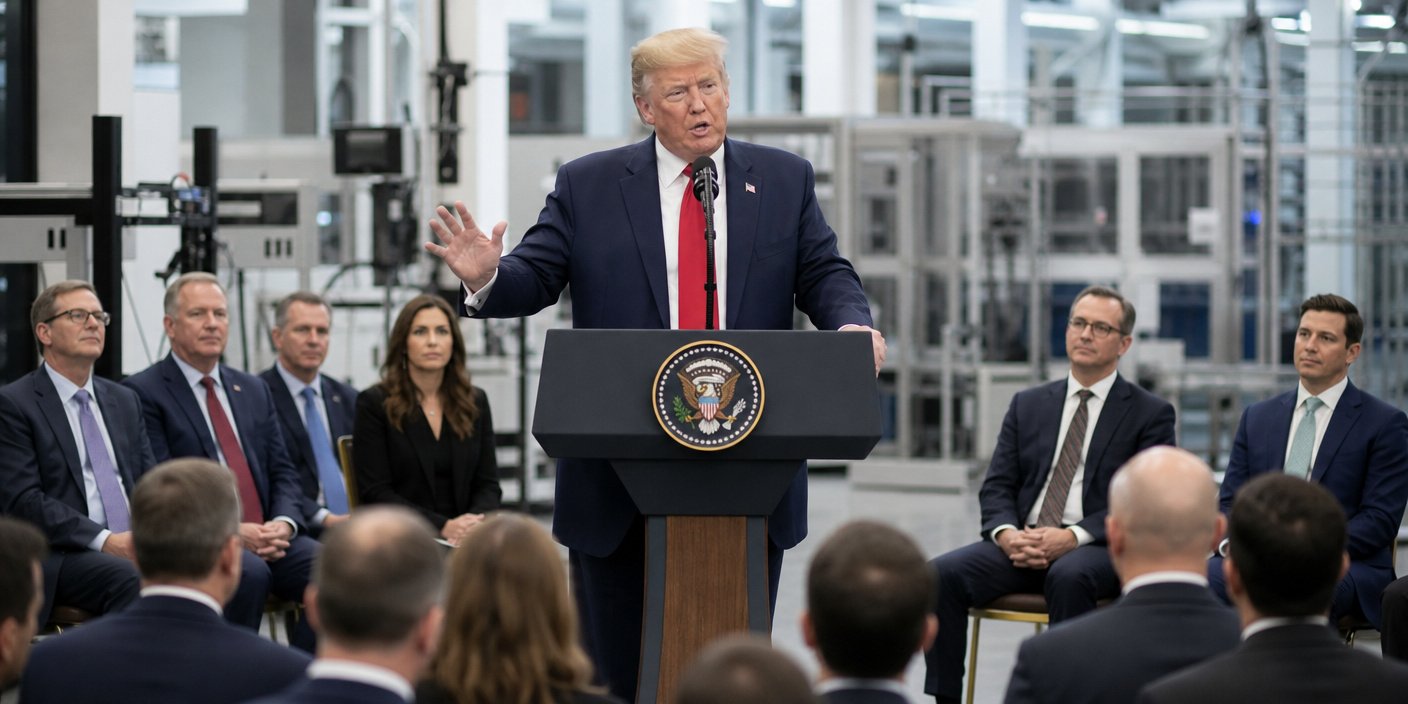


As the Federal Reserve approaches its pivotal FOMC meeting, the economic landscape is tightening around a singular point of friction: President Donald Trump’s aggressive campaign for interest rate cuts versus a market increasingly positioning itself for a hawkish pivot. The White House has made its stance clear, suggesting that current monetary policy is suffocating growth, while traders and analysts are pricing in the possibility of a rate hike—a scenario often associated with the fiscal philosophy of former Fed Governor Kevin Warsh. This divergence marks a significant moment for the central bank’s independence and future strategic direction.
The President’s Mandate: Growth Over Austerity
President Trump’s latest communication strategy regarding the Federal Reserve represents a departure from traditional executive reticence. By publicly demanding interest rate cuts, the administration is prioritizing immediate economic expansion and lowered borrowing costs for consumers and corporations. The President’s argument centers on the premise that the current high-rate environment is a self-imposed barrier to achieving potential GDP growth, arguing that inflation has been sufficiently tamed to warrant a pivot. This pressure is not merely rhetorical; it frames the narrative that the central bank’s current restrictive policy is an obstacle to the administration’s core economic agenda of sustained job creation and manufacturing revitalization. From the White House’s perspective, the delay in cutting rates is an indictment of the Fed’s bureaucratic caution, leaving them to wonder if the central bank is ignoring the signals of a cooling labor market.
The Warsh Factor: Why Markets are Hedging
Central to the current market volatility is the speculation surrounding former Fed Governor Kevin Warsh. Markets are not just reacting to data; they are speculating on personnel. The “Warsh Hike” thesis has gained traction among institutional investors who view Warsh as a staunch inflation hawk. If the market is betting on a hike, it is a bet that Warsh’s influence—or the anticipation of his policies—would necessitate a higher “neutral rate” to prevent long-term inflationary spikes. Warsh has historically prioritized the Fed’s credibility in stabilizing the dollar, often signaling that a preemptive strike against rising price levels is preferable to a reactive one. Consequently, bond yields have begun to reflect a “term premium” that accounts for the risk of persistent, higher interest rates, regardless of the immediate data. This has created a paradoxical situation where the administration calls for a easing, while the market prepares for a tightening.
FOMC Dynamics and Policy Divergence
The Federal Open Market Committee (FOMC) finds itself caught between these two competing pressures. The committee is tasked with a dual mandate: stable prices and maximum employment. Currently, the data shows a bifurcation. Unemployment metrics are showing signs of sensitivity to current interest rates, while core services inflation remains sticky. The divergence between the President’s call for cuts and the market’s pricing of a Warsh-inspired hike forces the FOMC into a precarious position. If the committee cuts rates to appease the executive branch, they risk accusations of political capitulation. If they hold or hike, they risk being blamed for a manufacturing or housing sector slowdown. The “Warsh Hike” speculation serves as a proxy for this tension, representing the belief that the institutional gravity of the Fed will eventually pull policy toward a more restrictive, inflation-focused stance rather than a growth-focused one.
The Path Forward: Inflation vs. Economic Velocity
Looking toward the next quarter, the economic impact of this standoff will likely manifest in the credit markets. Commercial real estate, which relies heavily on variable-rate financing, is particularly vulnerable to the uncertainty of this policy tug-of-war. If the market continues to bet on a hike, mortgage rates and corporate debt costs will remain elevated, even if the Fed holds rates steady. This is the danger of the current environment: the market’s expectations can do the heavy lifting of monetary policy, effectively tightening financial conditions without the Fed actually raising the federal funds rate. The administration’s public pressure is designed to break this expectation. By shifting the narrative toward rate cuts, the President aims to lower long-term yields, thereby easing financial conditions through sentiment alone. The success of this strategy, however, depends on whether the FOMC decides to look at the immediate pressure from the White House or the long-term historical imperative to curb inflation—a dilemma that Kevin Warsh has long argued should be solved with resolute, data-driven action, even if it is unpopular.