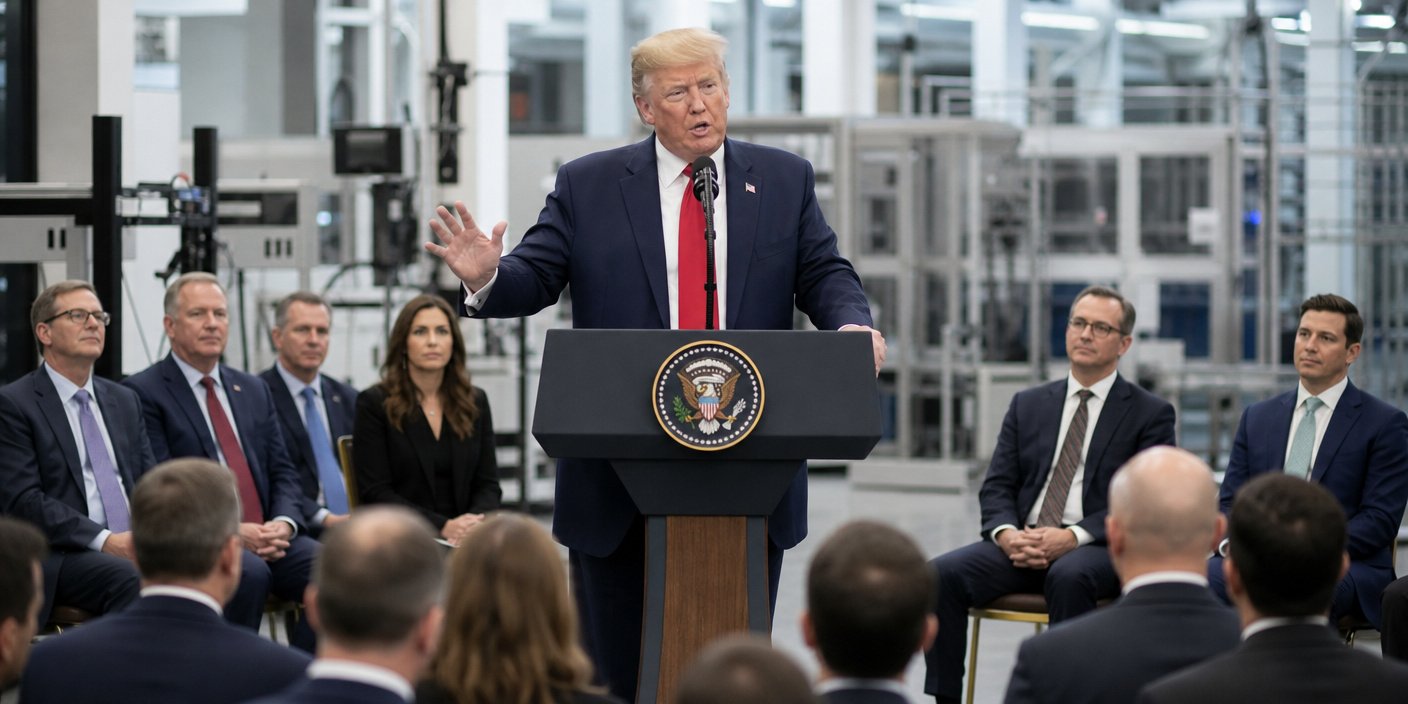
In a significant development reverberating across Washington, D.C., former President Donald Trump has called for the repeal of the CHIPS Act, a landmark piece of legislation designed to inject billions of dollars into the United States’ domestic semiconductor industry. This proposal has immediately ignited a fervent debate on Capitol Hill, challenging the consensus that underpinned the act’s passage and forcing lawmakers to reiterate their positions on the strategic importance of domestic chip production and research.
The Creating Helpful Incentives to Produce Semiconductors and Science Act of 2022, commonly known as the CHIPS Act, was enacted with bipartisan support with the explicit aim of revitalizing American manufacturing and research capabilities in the critical semiconductor sector. Semiconductors, often referred to as the “brains” of modern electronics, are fundamental components in everything from consumer devices and automobiles to advanced military systems. The legislation allocated substantial financial resources, amounting to billions of dollars, towards incentives for domestic semiconductor manufacturing, as well as funding for research and development initiatives.
The rationale behind the CHIPS Act centered on reducing reliance on foreign supply chains, particularly concerning advanced semiconductors manufactured primarily in Asia. Proponents argued that bolstering domestic production was essential for economic competitiveness, national security, and resilience against potential supply chain disruptions. The investment was framed not just as industrial policy, but as a necessary measure to secure America’s technological future and maintain its global leadership.
Trump’s Challenge and Capitol Hill Reaction
Former President Trump’s call for the repeal of this act represents a direct challenge to this established strategy. While the specific reasons articulated by Mr. Trump for his stance were not detailed in the provided context, the call itself has forced a public reckoning with the legislation’s impact and necessity.




The reaction on Capitol Hill has been swift and divided, highlighting the complexity of the issue and the differing perspectives even among members of the same party. Democrats, particularly those serving on the powerful House Science, Space and Technology subcommittee, have been vocal in defending the CHIPS Act. They have emphasized the law’s crucial importance for enhancing U.S. semiconductor manufacturing and research capabilities, arguing that it is already beginning to stimulate investment and job creation domestically.
These Democratic lawmakers contend that repealing the act would undermine the progress made and jeopardize America’s ability to compete on the global stage, particularly with rivals heavily investing in their own semiconductor industries. They point to the potential for the United States to regain a significant share of global chip production, a capability that has diminished substantially over the past few decades.
Concurrently, Republican senators have reportedly also asserted that the act is crucial for national security. This bipartisan acknowledgment of the link between semiconductor independence and defense capabilities underscores the strategic dimension of the CHIPS Act. The ability to domestically produce the sophisticated chips required for defense systems, telecommunications infrastructure, and critical technologies is seen by many as a non-negotiable element of national sovereignty and military readiness.
This reported stance among Republican senators suggests that support for the core objectives of the CHIPS Act extends beyond partisan lines, focusing instead on perceived geopolitical imperatives and the need to safeguard the nation’s technological edge.
Broader Implications of the Debate
The debate sparked by the call for repeal extends beyond the allocated billions; it touches upon fundamental questions about the government’s role in industrial policy, the nature of international competition, and the future trajectory of the U.S. economy in an increasingly technological world. A potential repeal, or even prolonged uncertainty surrounding the act’s future, could impact investment decisions by major semiconductor companies, who rely on the incentives and stability the law provides to justify building expensive fabrication plants, known as fabs, within the United States.
The billions of dollars in funding were designed to offset the higher costs associated with manufacturing semiconductors domestically compared to overseas locations. Removing this incentive structure could make U.S. investments less attractive, potentially slowing or halting the envisioned resurgence of American chipmaking.
The research component of the act is also critical. Funding for R&D is intended to ensure that the U.S. remains at the forefront of semiconductor innovation, developing the next generation of chip technologies. Opponents of repeal argue that abandoning this investment would cede technological leadership to other nations, with long-term consequences for both economic prosperity and national security.
Media Coverage Highlights Debate
The significance of this unfolding debate has not been lost on the media. News of President Trump’s call for repeal and the ensuing reactions on Capitol Hill have been widely covered. Notable reporting on the issue includes articles by Weslan Hansen in MeriTalk, Alexandra Kelley in Nextgov/FCW, and Alexander Bolton in The Hill. Their coverage has helped to illuminate the various facets of the debate, bringing attention to the perspectives of lawmakers and potentially shaping public understanding of the stakes involved.
As the discussion continues on Capitol Hill, the future of the CHIPS Act and the trajectory of the U.S. semiconductor industry hang in the balance. The differing views expressed underscore the complex challenges associated with maintaining technological superiority and economic security in a competitive global landscape. The call for repeal ensures that the strategic importance and effectiveness of the multi-billion-dollar investment in domestic chip capabilities will remain a central point of political contention.