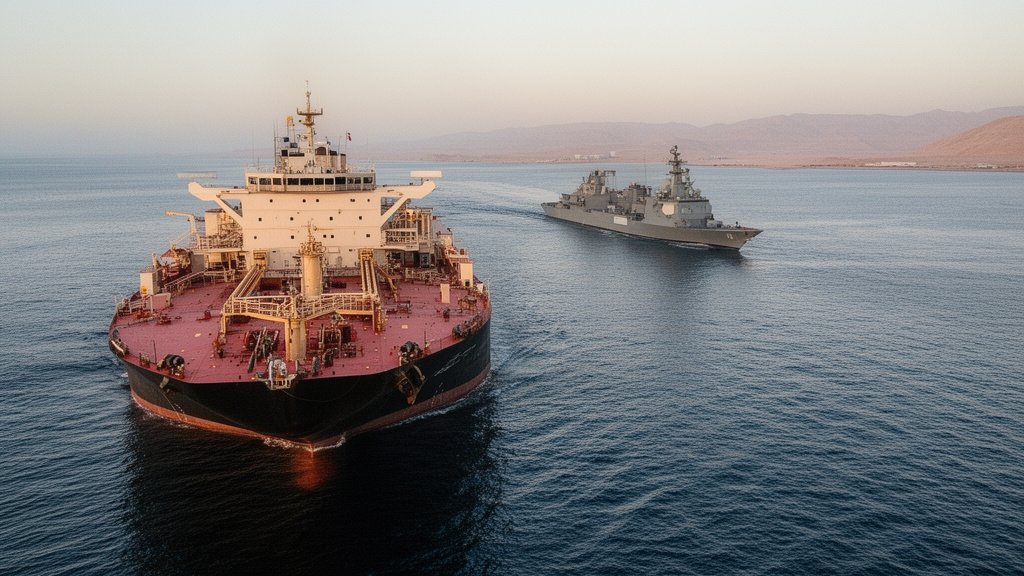
The United States military has issued a formal and categorical rejection of reports circulating through Iranian state media, which alleged that an uncrewed American military vessel was struck while transiting the strategically critical Strait of Hormuz. This rebuttal from Pentagon officials and Central Command (CENTCOM) comes at a moment of heightened regional volatility, compounding with the grim confirmation that seven individuals have been killed during intense combat operations in Southern Lebanon. The convergence of these two events highlights the fragile state of security across the Middle East, where disinformation campaigns and localized military escalations are increasingly testing the boundaries of international restraint.
The Strait of Hormuz Incident: A Pattern of Disinformation
The claim, which emanated from Iranian state-affiliated outlets, asserted that an uncrewed American naval platform had been targeted and damaged in the Strait of Hormuz—the world’s most important oil chokepoint. By swiftly characterizing these reports as categorically false, the US military is attempting to decouple its operational reality from a broader psychological and information warfare campaign.
US naval assets operating within the 5th Fleet’s area of responsibility, which encompasses the Persian Gulf, the Gulf of Oman, and the Red Sea, operate under strict rules of engagement. The use of Uncrewed Surface Vessels (USVs) and Uncrewed Underwater Vessels (UUVs) has increased significantly in recent years as the US seeks to counter asymmetric threats with persistent surveillance. Iranian claims of successful strikes on these platforms often serve dual purposes: signaling domestic strength to a local audience while testing the reaction time and transparency of US command structures. By immediately denying the incident, the US signaled that it would not allow its maritime posture to be defined by unverified adversarial narratives.
Escalation in Southern Lebanon: The Human Cost
While the maritime theater saw a war of words, the ground theater in Southern Lebanon saw lethal reality. Seven lives were claimed during the latest exchange of fire, a staggering number that underscores the lack of a durable ceasefire or de-escalation mechanism in the border region. The area, characterized by complex topography and deeply entrenched opposing positions, has seen a marked increase in the intensity of strikes and counter-strikes.



This loss of life is not merely a localized humanitarian tragedy; it acts as a bellwether for the broader regional conflict. Analysts observe that every engagement of this scale brings the combatants closer to a miscalculation that could shift the nature of the conflict from a managed border skirmish to a full-scale confrontation. The presence of international actors, including diplomatic envoys, remains focused on containing these skirmishes, yet the death toll suggests that current containment strategies are failing to act as an effective deterrent.
Geopolitical Implications and Regional Stability
The intersection of these two events—one an attempted information attack, the other a kinetic military engagement—presents a three-tiered challenge to regional stability:
1. Energy Market Vulnerability: The Strait of Hormuz is the conduit for approximately 20% of the world’s petroleum consumption. Any perceived instability, even disinformation-based, forces insurance premiums for maritime shipping to spike, creating economic ripples that are felt globally, from Tokyo to London.
2. The Proxy Dilemma: The Iranian state media’s attempt to frame a conflict in the Gulf, while simultaneous regional tensions flare in Lebanon, highlights the reality of the ‘ring of fire’ strategy. This involves simultaneous pressure points across the Middle East, intended to stretch US and allied military resources thin and complicate the strategic calculus of regional partners.
3. Command and Control Stress: The US military is forced to manage a dual-track response. It must project a position of strength and deterrence in the Persian Gulf to keep trade routes open while providing logistical and intelligence support in the Mediterranean/Levant theater. This dual demand requires high-tempo operations that increase the risk of burnout and technical error.
As the US continues to deny the validity of the Iranian claims, the maritime situation remains under intensified surveillance. Simultaneously, the situation in Lebanon remains in a state of high alert. Both theaters, separated by geography but linked by the regional actors involved, serve as a reminder that in the modern era of hybrid warfare, the battlefield is as much about the message as it is about the weapon.
FAQ: People Also Ask
Why does Iran frequently make false claims about striking US assets?
State-aligned media in Iran often utilizes disinformation as a low-cost tool for regional posturing. By claiming a victory against a superior technological power, they seek to boost domestic morale, deter regional adversaries, and complicate the diplomatic leverage of the United States without escalating to a full-scale direct conflict.
Why is the Strait of Hormuz strategically vital to the global economy?
The Strait of Hormuz is a narrow waterway connecting the Persian Gulf with the Gulf of Oman and the Arabian Sea. It is the primary chokepoint for oil tankers leaving the Middle East. If the Strait were closed or significantly disrupted, global oil prices would likely experience immediate and extreme volatility, affecting global inflation and energy security.
What is the typical US response to ‘uncrewed’ asset incidents?
The US Navy operates a sophisticated network of Task Forces (such as Task Force 59) dedicated to integrating drones into naval operations. When incidents occur, the US policy is to provide rapid, transparent disclosure to minimize market panic and counter adversary narratives. They emphasize that these vessels are under constant remote observation and that any ‘hit’ would be immediately detected and reported through official military channels, not via third-party media speculation.