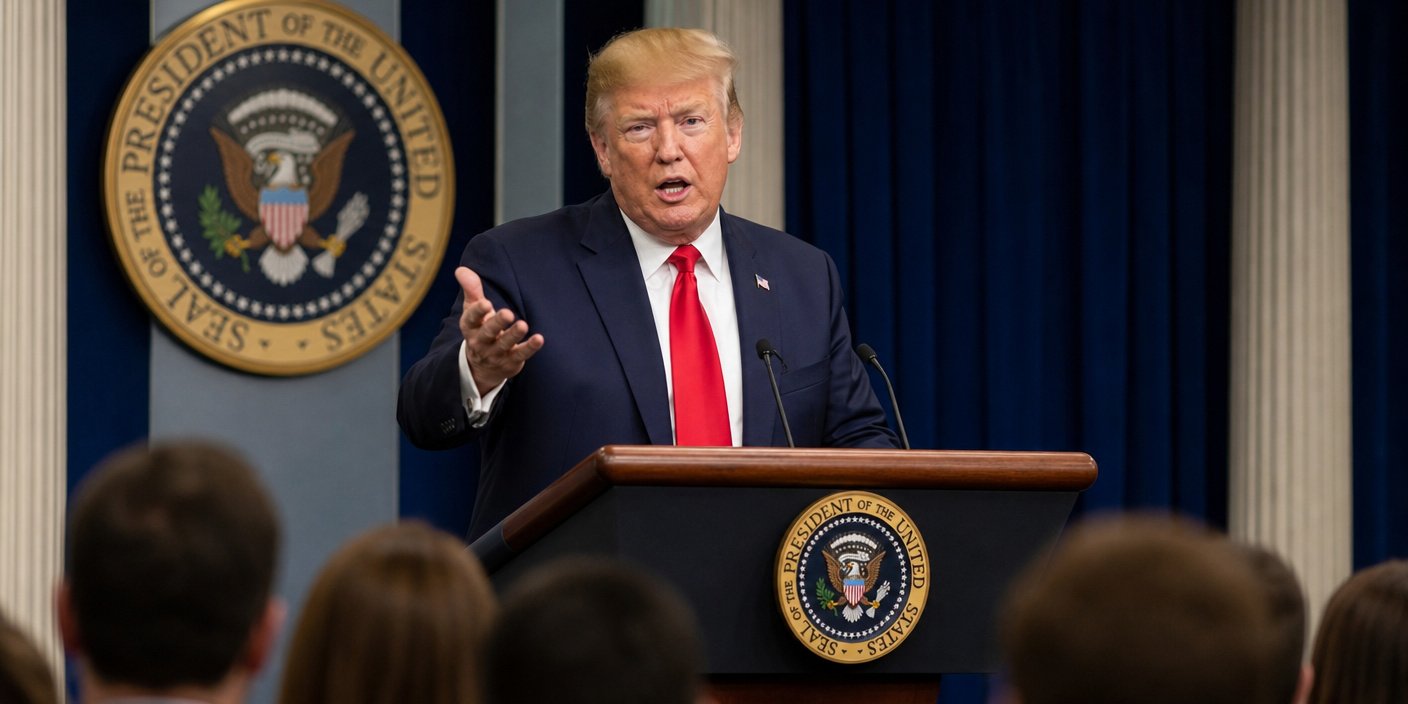
President Donald Trump has escalated his confrontation with the global leader of the Catholic Church, Pope Leo XIV, in an extraordinary series of public broadsides following the pontiff’s recent criticism of U.S. foreign policy in the ongoing Iran conflict. The feud, which has sent shockwaves through diplomatic and religious circles, centers on conflicting views regarding military engagement and the geopolitical stability of the Middle East, with both leaders effectively trading barbs over what many analysts are calling the most significant rift between the White House and the Holy See in modern history.
Key Highlights
- Unprecedented Tensions: President Trump publicly labeled Pope Leo XIV “weak on crime” and “terrible for foreign policy” following the pontiff’s remarks on the Iran war.
- Theological Dispute: The conflict stems from Pope Leo XIV’s recent suggestion that a “delusion of omnipotence” is fueling the U.S.-Israel military campaign in Iran, a statement the President interpreted as a direct challenge to his administration.
- Shift in Vatican Diplomacy: As the first American-born Pope, Leo XIV has navigated a complex path since his 2025 election, but his recent alignment against U.S. military strikes on Iranian infrastructure has brought the Vatican into direct collision with Washington.
- Geopolitical Stakes: With ceasefire negotiations currently stalled in Pakistan, the public spat threatens to further polarize U.S. domestic support for international involvement in the conflict.
The Anatomy of an Unprecedented Papal-Presidential Feud
The deterioration of the relationship between President Trump and Pope Leo XIV reached a fever pitch this weekend, following the President’s return to Washington from Florida. The spark for this latest verbal escalation appears to be a sermon delivered by the Pope at St. Peter’s Basilica, in which he implicitly criticized the moral justification for the ongoing military actions in Iran. While the Pope did not name the United States directly, his comments regarding “prayers of those who wage war” being rejected by God were widely interpreted by the White House as a direct rebuke of the administration’s strategy.
The ‘American Pontiff’ Paradox
Pope Leo XIV, formerly Cardinal Robert Prevost, took the Chair of St. Peter in May 2025 as the first American-born pope in history. His election was initially greeted with mixed reactions in the U.S., with some conservatives hoping for a pontiff who understood the American political landscape, while liberals hoped for a continuation of the social advocacy seen under Pope Francis.
However, the reality of the papacy has proven to be a complex exercise in navigating the nuances of global influence. Leo XIV, a former Augustinian priest with significant experience in missionary work in Peru, has adopted a diplomatic stance that frequently puts him at odds with the transactional and nationalist-leaning foreign policy often championed by the current White House. The tension is compounded by the fact that Leo is technically an American citizen, leading critics in the President’s inner circle to question his loyalties. Trump’s comment that the Pope is “catering to the Radical Left” suggests a perception that the Vatican has been co-opted by ideologies fundamentally incompatible with the administration’s “America First” doctrine.
The Iranian Flashpoint


At the center of this diplomatic firestorm is the escalating conflict in Iran. As the U.S. and Israel have ramped up airstrikes targeting Iranian infrastructure, the humanitarian and geopolitical costs have mounted. Pope Leo XIV has been consistent in his rhetoric, describing the sentiments justifying total warfare as “truly unacceptable.”
This criticism is not merely academic; it has real-world consequences for the optics of the war. For a President who relies heavily on the support of evangelical and conservative Catholic voting blocs, having the Pope publicly question the morality of his military policy creates a problematic dissonance. Trump’s retort—arguing that he does not want a Pope who believes it is acceptable for Iran to possess nuclear weapons—is a calculated attempt to reframe the debate from a moral issue to a national security imperative. By asserting that the Vatican is “weak on crime” and “terrible for foreign policy,” Trump is employing his classic strategy of preemptive strikes against perceived enemies, regardless of their institutional standing.
Media Wars and Social Signaling
Perhaps the most jarring aspect of this dispute is the medium of the conflict. The President’s use of social media to attack the head of the Catholic Church—a move previously unimaginable for a U.S. president—signals a fundamental shift in how the executive branch interacts with global institutions. The decision to air these grievances publicly, rather than through standard diplomatic channels, underscores a move toward populist governance that thrives on conflict-driven engagement.
Furthermore, the circulation of image-based posts by the President—allegedly depicting saint-like powers—suggests a deeply personal dimension to this feud. It is a battle for the narrative of moral authority. Trump is attempting to project himself as the pragmatic protector of Western interests, while casting the Pope as an out-of-touch moralizer. This conflict is likely to deepen as the war in Iran continues, with no clear path to de-escalation currently visible on the horizon.
FAQ: People Also Ask
Q: Why is Pope Leo XIV considered a ‘liberal’ by the Trump administration?
A: While Pope Leo XIV describes himself as a centrist, his advocacy for migration reform, environmental regulations, and his vocal skepticism regarding military interventions in sovereign nations have put him at odds with the Trump administration’s nationalist and militaristic policies, leading to the ‘liberal’ label from the President.
Q: Is this the first time a U.S. president has feuded with a pope?
A: While presidents and popes have often disagreed—most notably during the Cold War or over specific social issues—the level of personal attack and the frequency of public verbal warfare seen here is historically unprecedented and marks a departure from traditional statecraft.
Q: How does Pope Leo XIV’s American citizenship affect his role?
A: His American citizenship has added a layer of domestic political pressure to his papacy. It complicates his standing in Washington, as U.S. politicians often view him through the lens of domestic partisanship rather than as an independent religious leader.
Q: What is the current status of the U.S.-Iran negotiations?
A: Negotiations are ongoing in Pakistan amidst a fragile ceasefire, but the public spat between the U.S. and the Vatican has created an atmosphere of uncertainty, as the Pope’s public statements have influenced international discourse on the conflict’s legitimacy.