WASHINGTON D.C. – The complex Greenland Acquisition Dispute has surfaced with conflicting interpretations from the United States and Denmark. The White House announced a new working group for “technical talks on the acquisition of Greenland,” a statement immediately rebuffed by Denmark’s top diplomat. This divergence underscores significant diplomatic friction and the intricate geopolitical dynamics surrounding the Arctic island nation. The Greenland Acquisition Dispute presents a clear challenge to traditional alliances.
White House Press Secretary Karoline Leavitt articulated a clear agenda, emphasizing President Trump’s desire to acquire Greenland due to compelling U.S. national security interests. She confirmed that technical talks concerning this potential acquisition would proceed with Danish officials, framing Trump’s Greenland Acquisition Dispute interest as vital for national security and deterring adversaries in the Arctic. Leavitt also alluded to potential U.S. military options, a statement made after a high-level meeting involving Danish and Greenlandic delegations. This signals a renewed focus on US Greenland policy amidst growing Arctic geopolitical strategy concerns.
Denmark’s Rejection and Greenland’s Stance

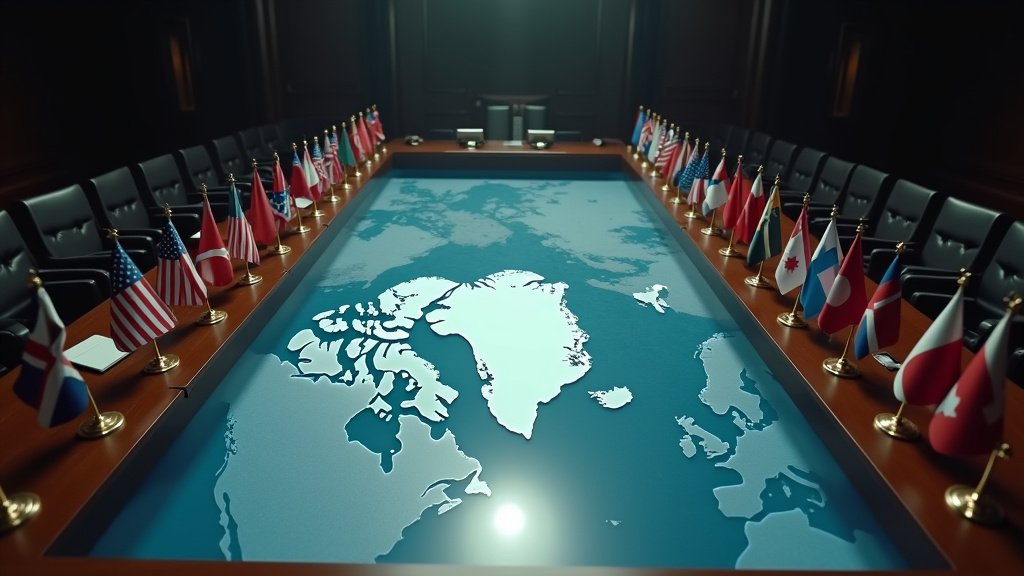
Denmark’s Foreign Minister Lars Løkke Rasmussen offered a starkly different perspective. While describing the talks as “frank but also constructive,” he highlighted a “fundamental disagreement” and explicitly rejected the U.S. position, stating any ideas disrespecting Denmark’s territorial integrity were “totally unacceptable.” Greenland’s own Foreign Minister Vivian Motzfeldt echoed this sentiment, strongly asserting Greenland’s right to self-determination. Their unified message was unequivocal: Greenland is not for sale, and Denmark firmly rejected the U.S. acquisition idea as a threat to their Danish territorial integrity. This firm stance created a deep divide, with the Danish government vowing to “prevent” any U.S. takeover.
Historical Context of the Greenland Acquisition Dispute
The U.S. interest in Greenland is not a recent phenomenon, with historical precedents dating back to World War II and the Cold War. President Harry S. Truman formally proposed purchasing Greenland in 1946 amidst rising Cold War tensions, an offer Denmark rejected but which led to expanded U.S. military access, including the establishment of Pituffik Space Base. Today, Greenland’s strategic location at the nexus of North America, Europe, and the Arctic remains crucial for military security and transatlantic movement. As geopolitical competition with Russia and China intensifies, the U.S. focus on the Arctic has heightened, driven by concerns about preventing adversary influence and monitoring Russian naval and Chinese infrastructure activities. President Donald Trump has been particularly vocal about pursuing a U.S. acquisition, viewing it as essential for national security and global freedom, further fueling the Greenland Acquisition Dispute.
Geopolitical and Economic Significance
Greenland holds immense geopolitical importance, not only for its strategic location on emerging Arctic shipping routes but also for its rich natural resources, including rare earth elements vital for modern technology. Western nations view these resources as a means to reduce dependence on China’s dominant supply chains, bolstering U.S. strategic independence. However, Greenland operates as a self-governing territory within the Kingdom of Denmark, which retains authority over its defense and foreign policy. Both Greenlandic and Danish authorities consistently reject any sale, emphasizing Danish sovereignty and Greenland’s own aspirations for self-determination and eventual independence. A majority of Greenlanders, around 85%, oppose an American takeover, adding a significant layer of local sentiment to the complex Greenland Acquisition Dispute.
International Reactions and Alliance Strains
The American pursuit of Greenland has undeniably strained alliances. European leaders have voiced significant concerns, with France warning that any U.S. acquisition could jeopardize its trade relationship with the European Union and labeling it a “crossed line.” Several European nations, including France and Germany, have increased their military presence in Greenland for exercises, signaling solidarity with Denmark and apprehension over U.S. actions. U.S. Senator Jeanne Shaheen has expressed worries that Trump’s rhetoric undermines alliances and inadvertently aids Russia and China, arguing that fracturing NATO is divisive and distracts from more critical goals like supporting Ukraine. This sentiment is shared by many Americans, with a recent poll showing only 17% supporting Trump’s acquisition efforts. A bipartisan group of senators has even introduced legislation to block a U.S. takeover without consent, highlighting concerns about damaging alliances and diverting focus, marking a clash between this American expansionism policy and traditional diplomacy.
The Core Impasse in the Greenland Acquisition Dispute
The “fundamental disagreement” over Greenland’s future remains starkly evident. While the White House labeled talks as “productive” and announced the working group’s formation, Denmark envisioned a group to explore finding a common way forward that addresses U.S. security concerns within Danish red lines. Conversely, the White House interpreted the group’s purpose as “technical talks on the acquisition,” directly contradicting Danish and Greenlandic assertions. Denmark has made it “very, very clear” that acquiring Greenland is not in the Kingdom’s interest and that the government intends to “prevent” such a scenario. Greenland’s government has unequivocally stated they “cannot under any circumstances” accept U.S. demands and “do not want to be Americans,” emphasizing their status as part of the Kingdom of Denmark. This contradictory framing presents an immediate hurdle for the working group, highlighting the deep chasm between American ambition and Danish sovereignty in the ongoing Greenland Acquisition Dispute.
Conclusion: Navigating a Complex Geopolitical Landscape
In conclusion, the formation of the working group marks a new phase in the escalating rhetoric surrounding the Greenland Acquisition Dispute. The White House’s claims about the group’s purpose directly clash with Denmark’s unwavering stance on sovereignty and self-determination. While the U.S. interest is driven by strategic location, resources, and geopolitical competition, these ambitions have strained vital alliances, prompting increased Arctic presence from European partners and concern from U.S. senators. The diplomatic standoff continues, underscoring the precarious balance in the Arctic’s complex geopolitical landscape. This top American story highlights the challenges arising when national security interests intersect with international law and allied relations, making the future of Greenland an unfolding narrative.