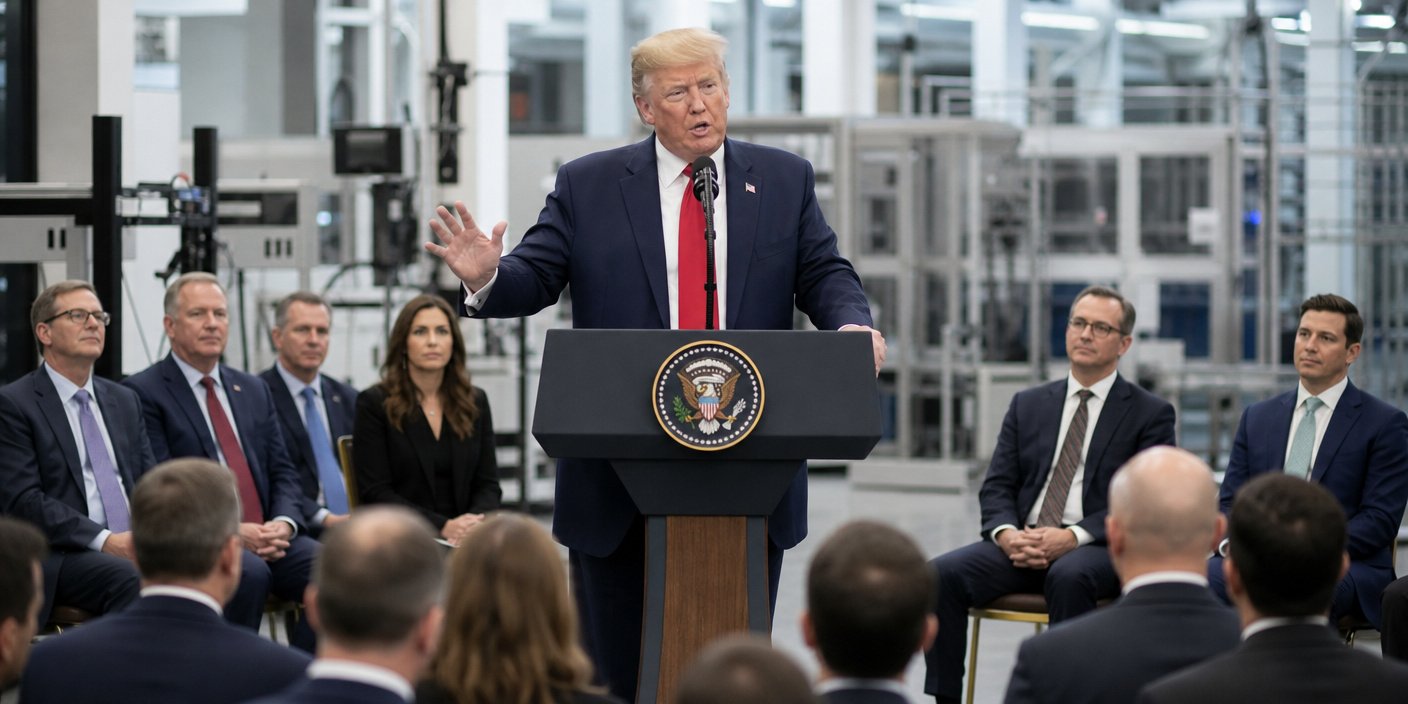

President Donald Trump has announced plans for a new summit with Russian President Vladimir Putin in Budapest, Hungary, aimed at discussing an end to the ongoing war in Ukraine. This surprising development emerged following a “productive” phone call between the two leaders and comes just as Ukrainian President Volodymyr Zelenskyy arrived in Washington for crucial talks with President Trump.
Trump’s Diplomatic Gambit: A New Summit with Putin
Following a lengthy telephone conversation on Thursday, President Trump declared that he and President Putin would meet in Budapest to “see if we can bring this ‘inglorious’ War, between Russia and Ukraine, to an end”. The announcement follows a pattern of high-level engagements between the USA and Russia concerning the conflict, though previous summits, such as the one held in Alaska in August 2025, have not yielded significant breakthroughs. High-level advisors from both nations, to be led by U.S. Secretary of State Marco Rubio, are expected to meet first, with the leaders’ summit anticipated within the next two weeks. Hungarian Prime Minister Viktor Orbán has enthusiastically welcomed the plan, with Budapest serving as a potential neutral ground, a move that has drawn international attention given Hungary’s unique relationship with Moscow within the European Union.
Zelenskyy’s Washington Visit: Seeking Crucial Support
President Zelenskyy’s visit to Washington D.C. on Friday was primarily aimed at securing continued U.S. support, particularly the provision of advanced long-range weaponry such as Tomahawk missiles. These missiles would significantly enhance Ukraine’s capability to strike deep into Russian territory, a move Kyiv believes could compel Moscow to negotiate a genuine peace settlement. However, President Putin has warned that such an arms transfer would be a “provocation” and would “cause substantial damage to the relationship between our countries,” potentially derailing peace efforts. President Trump himself has expressed skepticism about supplying these missiles, citing the need to maintain U.S. stockpiles. The timing of the Trump-Putin call, just before Zelenskyy’s scheduled meeting, has led some analysts to suggest it is a Russian tactic to deflect pressure and delay potential U.S. military aid.
Geopolitical Chessboard: Raising the Stakes
The announcement of a direct Trump-Putin summit on Ukraine has significantly raised the stakes for President Zelenskyy’s discussions in Washington. While President Trump has recently voiced growing frustration with President Putin and expressed optimism about Ukraine’s potential to regain lost territory, his conciliatory tone following the call with Moscow has cast uncertainty over the near-term likelihood of receiving enhanced U.S. military support. The diplomatic maneuvering highlights a complex geopolitical landscape where American national security interests are deeply intertwined with the protracted conflict in Eastern Europe. This ongoing news cycle underscores the delicate balance of power and the myriad challenges in achieving a lasting peace.
Historical Context and Future Uncertainty
Previous engagements between Trump and Putin, including the Alaska summit in August 2025, failed to produce a definitive ceasefire or peace agreement, leaving many observers wary of new diplomatic initiatives without concrete outcomes. President Trump has positioned himself as a peacemaker, aiming to resolve the conflict that began with Russia’s full-scale invasion of Ukraine in 2022. However, the competing agendas and entrenched positions of Russia and Ukraine, coupled with the complex dynamics of U.S. foreign policy, mean that the path to a resolution remains fraught with uncertainty. The upcoming meetings, both between Trump and Zelenskyy, and the planned summit with Putin, will be closely watched for any shifts in the national and international response to the war.