Skip to content
Trending
March 20, 2025House Oversight Probes EPA’s Handling of $20 Billion Greenhouse Gas Fund June 2, 2025India Faces Critical AI Skills Gap: Report Forecasts Need for 1 Million Professionals by 2026 April 10, 2025Hollywood’s China Problem: Trade War Escalation Threatens Crucial Film Market Access July 6, 2025Texas Flash Floods: Death Toll Reaches 51 Amid Search for Missing Children June 29, 2025US Senate Advances Trump’s Sweeping ‘Big Beautiful Bill’ in Contentious Vote May 2, 2025Gaza Crisis Deepens: WHO Warns of Starvation as Aid Flotilla Attacked Near Malta July 17, 2025Trump Revokes $4 Billion in Federal Funds, Halting California High-Speed Rail Project June 24, 2025WatchGuard Unveils Total MDR: AI-Driven, Full-Stack Security Revolution for MSPs September 26, 2025Trump Slaps 100% Pharma Tariffs, Jolting Indian Stocks and Global Trade Landscape August 20, 2025Pyongyang Declares Seoul No Longer Diplomatic Partner Amidst Escalating Tensions and Joint Military Drills
  • Home
  • Top Stories
  • National News
  • Health
  • Business
  • Tech & Innovation
  • Entertainment
  • Politics
  • Culture & Society
  • Crime & Justice
  • Editorial
  • Home
  • Top Stories
  • National News
  • Health
  • Business
  • Tech & Innovation
  • Entertainment
  • Politics
  • Culture & Society
  • Crime & Justice
  • Editorial
  • Blog
  • Forums
  • Shop
  • Contact
  Tech & Innovation  AI Drives Computing Revolution: GPUs Power a New Era of Supercomputers
Tech & Innovation

AI Drives Computing Revolution: GPUs Power a New Era of Supercomputers

Michelle CarterMichelle Carter—March 17, 20254
FacebookX TwitterPinterestLinkedInTumblrRedditVKWhatsAppEmail

The global race to achieve breakthroughs in artificial intelligence (AI) is fundamentally reshaping the architecture of modern computing. This transformative shift is being spearheaded by an unlikely champion: the graphics processing unit (GPU), originally designed to render complex visuals for video games. These chips possess a parallel processing capability that has proven exceptionally well-suited for the demanding calculations inherent in AI models.

In response to the escalating computational needs of advanced AI systems, technology companies are now undertaking a significant engineering feat. They are densely packing these powerful GPUs into specialized computer clusters, giving rise to a new class of supercomputer specifically optimized for AI workloads. These sophisticated machines are a far cry from traditional server racks.

GPUs: The Engine of AI Calculations

For decades, central processing units (CPUs) have been the backbone of general-purpose computing. However, the nature of AI tasks, particularly the training and inference of deep learning models, requires massive parallel processing — performing many calculations simultaneously. This is precisely where GPUs excel. Their architecture, built to handle thousands of concurrent operations needed for graphics rendering, aligns perfectly with the matrix multiplications and other mathematical operations that dominate AI computations.


More stories

From Gaming Pixels to AI Powerhouses: GPUs Reshape Global Computing Architecture

March 17, 2025

State Attorneys General Poised to Guard Consumers Amid Rapid Federal AI Innovation Push

March 14, 2025

Meta Secures Apple AI Chief Ruoming Pang in Landmark Hiring Worth Over $200 Million

July 10, 2025

OMRON and Dassault Systèmes Unite to Revolutionize Manufacturing

April 21, 2026

The realization that GPUs could accelerate AI development has fueled unprecedented demand. What began as a niche application has quickly evolved into the primary driver behind the development and deployment of the most powerful computing systems on Earth today. Companies are now investing billions not just in the chips themselves, but in the infrastructure required to harness their collective power.

Building the Modern AI Supercomputer

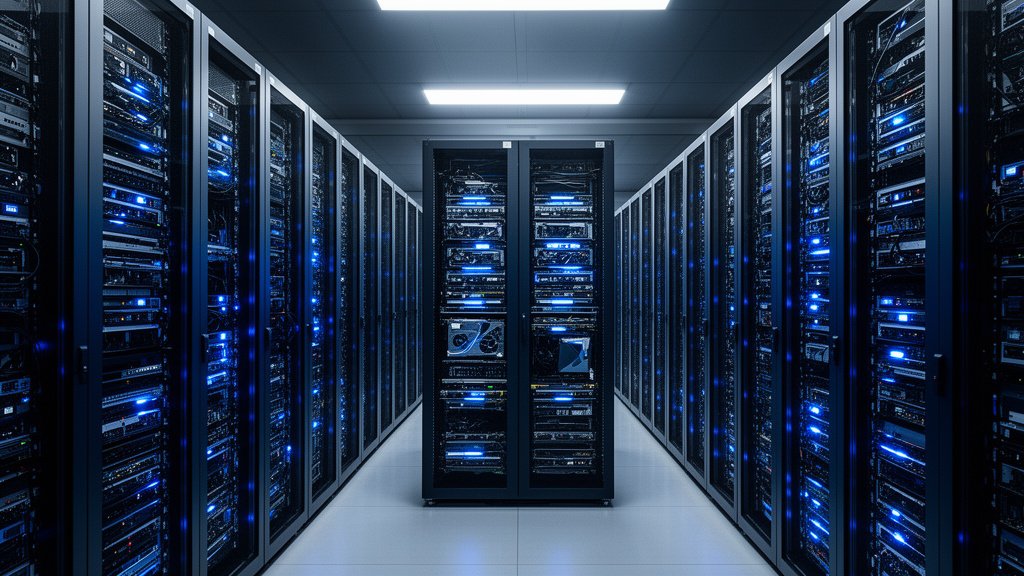
The construction of these next-generation AI supercomputers involves connecting vast numbers of GPUs. Unlike standard server deployments, these setups require intricate high-speed networking to allow the chips to communicate and share data efficiently during massive training runs. The scale is staggering: these specialized computers can consist of up to 100,000 individual chips wired together.

These dense clusters are housed within sprawling data centers, the digital factories of the 21st century. The engineering challenge extends beyond simply assembling chips; it involves designing sophisticated cooling systems, managing immense power demands, and building complex network topologies to ensure seamless communication across the thousands of interconnected processors. This integrated approach is necessary to enable the scale and performance required to train the largest and most complex AI models currently being developed.

The Foundation: Decades of Data Center Investment

This current phase of AI-driven computing is built upon a pre-existing global infrastructure footprint. Big technology companies have been constructing computer data centers across the globe for two decades. This long-term investment in physical facilities, power grids, and network connectivity has inadvertently laid the groundwork for the rapid expansion of AI supercomputing capacity today. Existing data center campuses are being retrofitted or expanded to accommodate the unique requirements of GPU-dense systems, or entirely new facilities are being purpose-built.

The ability to leverage this established infrastructure allows tech giants to deploy AI capabilities at scale relatively quickly, despite the complexity and expense of the new hardware. This legacy of data center construction is a critical, though often overlooked, factor in the current acceleration of AI development and deployment worldwide.

The Future Forged in Silicon

The reliance on GPUs and the construction of these specialized supercomputers underscore a pivotal moment in computing history. The demands of artificial intelligence are not merely increasing the quantity of computation but fundamentally altering its nature and the systems required to perform it. This shift has profound implications for the technology industry, from chip design and manufacturing to data center operations and software development.

As the pursuit of more powerful and versatile AI continues, the evolution of computing hardware is set to remain a dynamic and central theme. The journey from video game graphics to AI powerhouses highlights the unexpected pathways of technological innovation and the relentless drive to build ever more capable machines to tackle the world’s most complex computational challenges. This report was authored by Cade Metz, Karen Weise, Marco Hernandez, Mike Isaac, and Anjali Singhvi.
author avatar
Michelle Carter
See Full Bio
FacebookX TwitterPinterestLinkedInTumblrRedditVKWhatsAppEmail

Michelle Carter

Trump Administration Defies Federal Judge on Deportation Flights to El Salvador, Invoking 1798 Law
AI’s Deep Impact: How GPUs Are Reshaping the Core Architecture of Global Computing
Related posts
  • Related posts
  • More from author
Tech & Innovation

Europe’s AI Giant: Ineffable Raises $5.1B Seed Round

April 28, 20260
Tech & Innovation

OMRON and Dassault Systèmes Unite to Revolutionize Manufacturing

April 21, 20260
Tech & Innovation

Beauty’s Digital Twin: Groupe Rocher & Dassault Systèmes Partner

April 14, 20260
Load more
Read also
Top Stories

James Comey Indicted: New Legal Battle Over ’86 47′ Social Media Threat

April 29, 20260
Politics

Supreme Court Weighs Fate of TPS Migrant Protections

April 29, 20260
Editorial

James Comey Indicted: DOJ Cites ’86 47′ Shell Photo as Threat

April 29, 20260
National News

James Comey Indicted: DOJ Targets ’86 47′ Social Media Post

April 29, 20260
Top Stories

Athens in Shock: 89-Year-Old Gunman Targets Security Office, Court

April 28, 20260
Top Stories

Trump Assassination Attempt Suspect Charged: Legal Fallout Follows WHCD Shooting

April 28, 20260
Load more

Recent Posts

  • James Comey Indicted: New Legal Battle Over ’86 47′ Social Media Threat
  • Supreme Court Weighs Fate of TPS Migrant Protections
  • James Comey Indicted: DOJ Cites ’86 47′ Shell Photo as Threat
  • James Comey Indicted: DOJ Targets ’86 47′ Social Media Post
  • Athens in Shock: 89-Year-Old Gunman Targets Security Office, Court

Recent Comments

No comments to show.
Social networks
FacebookLikes
X TwitterFollowers
PinterestFollowers
InstagramFollowers
YoutubeSubscribers
VimeoSubscribers
Popular categories
  • Top Stories531
  • National News298
  • Editorial265
  • Business253
  • Politics251
  • Crime & Justice235
  • Entertainment231
  • Health202
  • Tech & Innovation195
  • Culture & Society190
  • Uncategorized2

James Comey Indicted: New Legal Battle Over ’86 47′ Social Media Threat

April 29, 2026

Supreme Court Weighs Fate of TPS Migrant Protections

April 29, 2026

James Comey Indicted: DOJ Cites ’86 47′ Shell Photo as Threat

April 29, 2026

James Comey Indicted: DOJ Targets ’86 47′ Social Media Post

April 29, 2026

Athens in Shock: 89-Year-Old Gunman Targets Security Office, Court

April 28, 2026

Awards Season Culminates: Previewing the 97th Academy Awards and Weekend Entertainment Options

4534 Comments

S&P 500 Nears Record as Nasdaq Hits Three-Week High; Major Indexes Post Strong Weekly Gains on February 14, 2025

779 Comments

Google Introduces Premium AI Ultra Subscription Globally: Advanced Capabilities and Pricing Details Emerge

771 Comments

Trump Rallies GOP on Capitol Hill Amidst Doubt for Sweeping Domestic Policy Bill

582 Comments

Future of Telecom: How AI and 5G Convergence is Driving Innovation

542 Comments
    © Copyright 2025, All Rights Reserved
    • About
    • Privacy
    • Contact