The United States has initiated a significant recalibration of its military posture in the Middle East, deploying a robust contingent of 2,000 Marines into the region alongside the movement of three carrier strike groups toward Iran. This strategic pivot comes as regional stability hangs in the balance following a targeted projectile strike on a major supertanker within the Strait of Hormuz, a critical chokepoint for global energy markets. The developments mark a sharp increase in maritime tension and a clear signal of deterrence from the Department of Defense regarding the security of international shipping lanes.
Key Highlights
- Strategic Reinforcement: 2,000 Marines from the Bataan Amphibious Ready Group have been ordered to bolster regional readiness and deterrence capabilities.
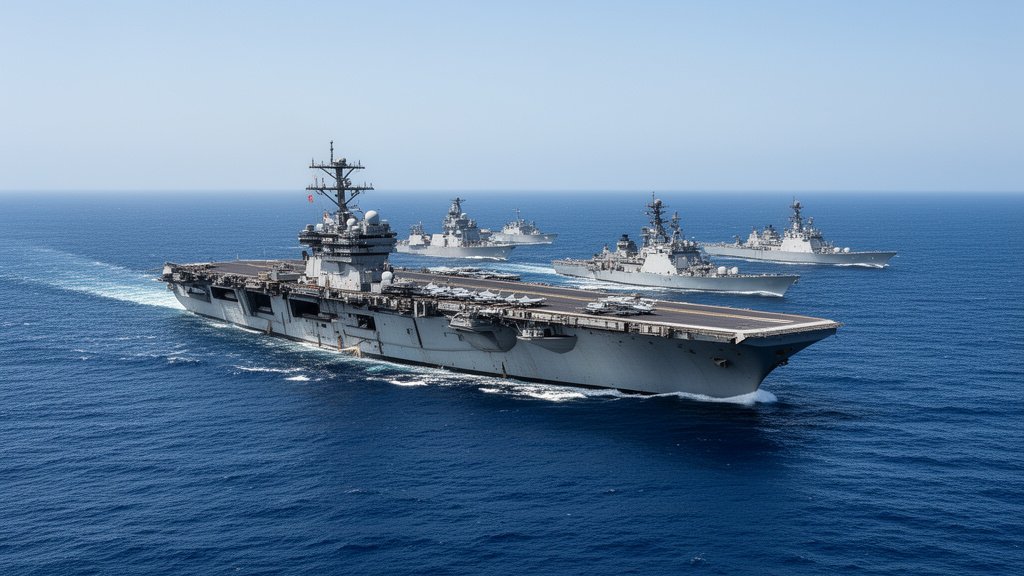
- Naval Escalation: Three carrier strike groups are moving into position to provide comprehensive aerial and naval coverage across the Persian Gulf.
- Maritime Security Breach: A projectile strike on a major supertanker in the Strait of Hormuz has triggered urgent diplomatic and security reviews regarding the safety of commercial vessels.
- Chokepoint Sensitivity: The Strait of Hormuz remains a central nervous system for the global economy, with approximately 20-30% of the world’s daily oil consumption transiting its narrow waters.
The Geometry of Power Projection in the Gulf
The arrival of 2,000 Marines, specifically drawn from the Bataan Amphibious Ready Group and the 26th Marine Expeditionary Unit, represents a tactical shift towards rapid-response capability. By integrating these amphibious forces with the overwhelming firepower of three carrier strike groups, US Central Command (CENTCOM) is effectively establishing a ‘hard’ deterrent buffer. This deployment is not merely a logistical movement; it is a communication of intent. The naval assets, capable of projecting power across thousands of miles through carrier-based aviation, are intended to monitor, escort, and, if necessary, defend commercial shipping from interference.
The Hormuz Flashpoint
The Strait of Hormuz has long been the world’s most critical maritime chokepoint. The recent projectile strike on a supertanker—a vessel carrying millions of barrels of crude oil—underscores the vulnerability of the global supply chain to asymmetric threats. Military analysts note that while such strikes are often designed to remain below the threshold of all-out war, they create significant risk for shipping insurers, which can lead to spike in global energy prices. By saturating the area with naval assets, the US is attempting to lower the ‘threat floor,’ ensuring that maritime transit remains viable despite the provocative environment.
Economic Ripples and Global Dependence



The global economy functions on the predictability of the Strait of Hormuz. When maritime security is compromised, the immediate impact is felt in the futures markets. Energy commodities are highly sensitive to geopolitical ‘noise,’ and the presence of US military hardware serves as a stabilizer for maritime insurance premiums. If shipping lanes are deemed unsafe, companies often divert vessels around the Cape of Good Hope, a costly and time-consuming alternative that effectively taxes the global consumer. The deployment of the three carrier strike groups is, in many respects, a macroeconomic safeguard designed to keep global energy flow uninterrupted.
Escalation Protocols and Deterrence
Military doctrine in this theater involves a complex dance of escalation control. The objective of the deployment is twofold: to deter potential aggressors from seizing commercial vessels and to demonstrate the capacity for a coordinated, multi-theater response. US forces are engaging in close communication with regional allies, such as the Gulf Cooperation Council (GCC) states, to synchronize maritime domain awareness. This intelligence sharing ensures that the presence of the 2,000 Marines is not viewed as a prelude to invasion, but as a commitment to the freedom of navigation—a cornerstone of international law and a priority for the International Maritime Organization (IMO).
Future Outlook: Navigating Uncertainty
As the Marines establish their staging areas and the carrier groups settle into their patrol patterns, the coming weeks will likely see an uptick in exercises and ‘freedom of navigation’ operations. These drills are intended to demonstrate interoperability and resolve. However, the situation remains fluid. The primary challenge for US leadership will be maintaining the ‘Gray Zone’—the space between peace and open conflict—where deterrence is effective without accidental escalation. Analysts suggest that the duration of this enhanced presence will be dictated by the frequency of maritime incidents and the evolving threat assessment from regional intelligence agencies.
FAQ: People Also Ask
Q: Why is the Strait of Hormuz considered so critical to the global economy?
A: It is the world’s most important oil chokepoint, with approximately 21 million barrels of oil passing through daily, representing roughly 20-30% of global daily oil consumption. Any disruption here causes immediate global price volatility.
Q: What is the specific role of the 2,000 Marines deployed to the region?
A: These Marines provide a versatile, rapid-response capability. They can be utilized for maritime security, protection of assets, and providing a ground-based deterrent that can be deployed quickly from amphibious ships to land or vessel environments as needed.
Q: How does a carrier strike group impact the regional security environment?
A: A carrier strike group (CSG) is a self-contained combat force. It includes an aircraft carrier, cruisers, destroyers, and submarines. Its presence provides the US with dominant air superiority, extensive surveillance capabilities, and the ability to strike targets or defend shipping lanes with pinpoint accuracy from a standoff distance.
Q: What are the risks of the current military buildup?
A: The primary risk is ‘accidental escalation.’ In a crowded maritime environment where multiple nations operate their own naval forces, a miscalculation or a misunderstanding of maneuvers can rapidly spiral into a kinetic confrontation, which the deployment aims to prevent through overwhelming, visible deterrence.