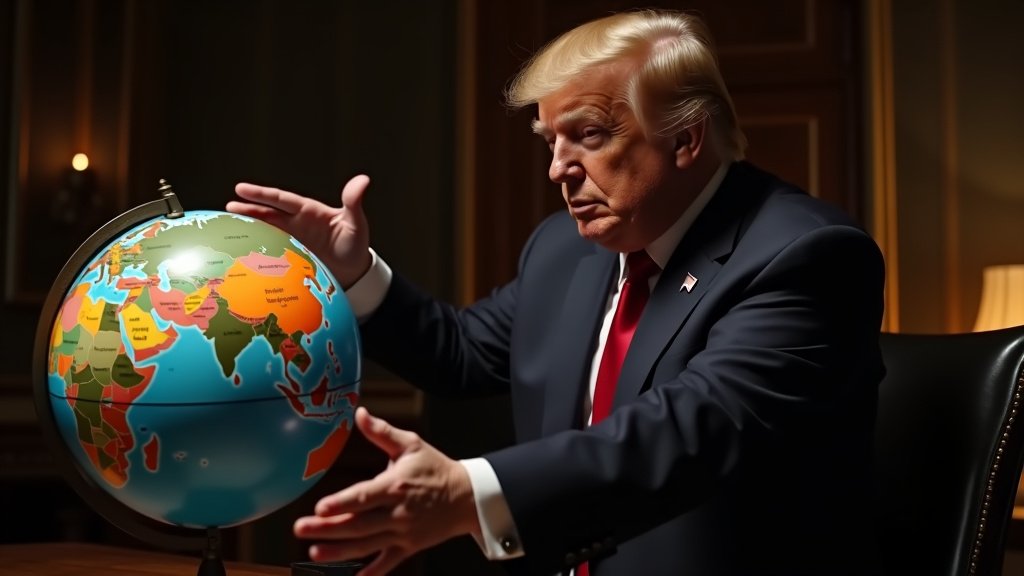
President Trump expressed frustration Tuesday, stating that NATO and a majority of other allies have declined his requests for assistance in securing the Strait of Hormuz. He voiced his displeasure that the U.S. is not receiving support for the conflict in Iran, despite his administration’s assertion that the action is for global good.
- NATO and other allies have rejected President Trump’s calls to help secure the Strait of Hormuz.
- Trump claims the U.S. is not receiving support despite having aided NATO significantly.
- Allies in Japan, Australia, and South Korea, along with China, have also rejected involvement.
- The European Union’s top diplomat stated the bloc does not wish to be drawn into the U.S.-Iran conflict and was not consulted.
- Trump indicated that the U.S. might reconsider its relationship with NATO and is considering acting alone.
- The conflict, now in its third week, has caused global economic reverberations.
Diplomatic Friction and a Solitary Stance


President Trump voiced strong dissatisfaction with NATO and other international partners for their refusal to contribute to securing the Strait of Hormuz amidst the ongoing conflict with Iran. The President asserted that these allies have not reciprocated the support the U.S. has provided them, citing past U.S. backing for Ukraine as an example. Trump’s frustration stems from what he perceives as a lack of solidarity from traditional allies, particularly in a situation he considers vital for global security and economic stability. The Strait of Hormuz is a critical chokepoint for global oil exports, with approximately 20% of the world’s crude oil passing through it daily in normal times. Nations in Asia are particularly vulnerable to trade disruptions due to their heavy reliance on imported fuel shipped through this waterway.
Allies’ Hesitation and EU’s Position
The reluctance of allies to join the initiative has led Trump to suggest that the U.S. may need to proceed independently. The European Union’s chief diplomat, Kaja Kallas, explicitly stated that the 27-nation bloc does not wish to be involved in the U.S.-led war against Iran, emphasizing that it is “not Europe’s war” and that member states were not consulted. This diplomatic pushback highlights a divergence in foreign policy priorities and a desire by some European nations to avoid escalation or entanglement in conflicts they did not initiate. Kallas further noted that the objectives of the war are unclear to the EU, and member states do not want to be drawn into it.
Trump’s Strategic Doubts and Path Forward
Trump’s response to the allies’ refusal underscores the international community’s perception that the responsibility for resolving the conflict rests largely on his shoulders. He expressed surprise that allies did not offer even minimal assistance, such as sending minesweepers, which he deemed a low-cost contribution. The conflict, now in its third week, has already sent ripples across the global economy. Despite the lack of broad international backing, Trump has maintained that the U.S. does not necessarily need assistance, suggesting a potential shift towards a unilateral approach. This stance raises questions about the future of U.S. alliances and its role in international security, especially given the significant U.S. investment in European and Asian defense infrastructure. The U.S. military has reportedly conducted strikes on Iranian missile sites, indicating a continued commitment to its objectives in the region.
FAQ: People Also Ask
Q: What is the Strait of Hormuz and why is it important?
A: The Strait of Hormuz is a narrow waterway connecting the Persian Gulf to the Gulf of Oman and the open sea. It is a crucial chokepoint for global oil and gas transportation, with a significant portion of the world’s oil supply passing through it daily.
Q: Why are NATO allies hesitant to get involved in the Strait of Hormuz situation?
A: NATO allies are hesitant due to various reasons, including a lack of consultation, a desire not to be drawn into a conflict they did not initiate, and differing foreign policy objectives. Some also view NATO as a defensive alliance not suited for offensive operations.
Q: What is President Trump’s current strategy regarding the Strait of Hormuz?
A: President Trump has expressed frustration with allies’ refusal to help and has indicated a willingness for the U.S. to act alone. He has also employed strong rhetoric, including threats against Iranian infrastructure, as part of his strategy to pressure Iran.