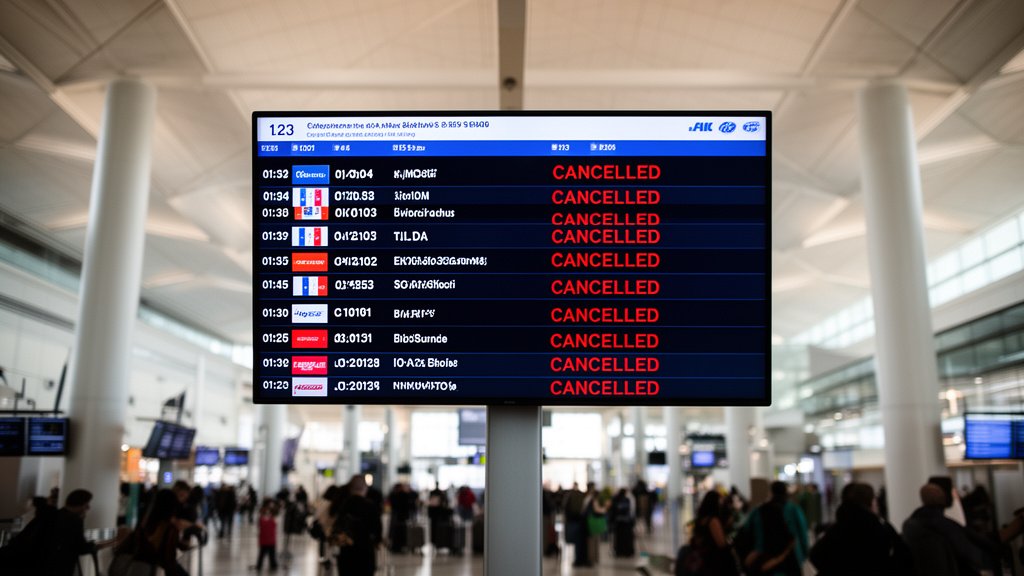
The skies over the United States are returning to normalcy following a historic and disruptive four-hour nationwide ground stop. The Federal Aviation Administration (FAA) has announced that operations are recovering as of November 15, ending a period of turbulence that grounded thousands of flights and paralyzed major transit hubs across the country. This event, which stands as the longest nationwide ground stop in a quarter-century, has ignited a necessary, rigorous conversation regarding the modernization of critical national infrastructure.
Key Highlights
- Historic Disruption: The four-hour nationwide ground stop is officially classified as the longest disruption to U.S. air travel in the last 25 years.
- Technical Root Cause: The failure was identified as a systemic overload within legacy air traffic control infrastructure, triggered by the integration of new, modernized technology protocols.
- Recovery Timeline: Following emergency mitigation efforts, the FAA reports that air travel is recovering steadily, with full operational status expected by the end of November 15.
- Systemic Vulnerability: This incident highlights the acute risks associated with maintaining aging software frameworks while attempting to implement advanced technological upgrades.
Anatomy of the Infrastructure Crisis
The events of November 15 represent a breaking point for a system that has long been described by aviation experts as being underfunded and overdue for a comprehensive digital overhaul. For four hours, the U.S. airspace, typically one of the most efficient and robust networks in the world, came to a virtual standstill. The decision to ground all flights—a move rarely utilized by the FAA—was taken not out of an abundance of caution, but as a mandatory safety measure required by the catastrophic failure of internal data transmission pathways.
The Legacy System Paradox
The core of the issue lies in the collision between 21st-century aviation requirements and 20th-century computing backbones. The FAA has been working to migrate from older, legacy air traffic control systems to more agile, cloud-based architectures. However, this transition is not merely a “lift and shift” operation. It involves complex layers of middleware designed to translate modern digital signals into a format that aging mainframe systems can process. During the November 15 incident, the ingestion of new data protocols created a “data storm,” overwhelming the legacy hardware’s memory and processing capacity. This cascade failure essentially blinded parts of the network, forcing controllers to issue a nationwide stop to ensure the safety of aircraft already in the air and to prevent the launch of new flights into an unmonitored environment.
Economic and Logistical Impact




The ripple effect of a four-hour ground stop is not linear; it is exponential. When the FAA stops all departures, the delay chain begins to lengthen immediately. Aircraft were stuck at gates, crews timed out of their allowable service hours, and passenger connections were missed in major hubs like Atlanta, Chicago, and New York. Airlines operate on precise, minute-by-minute schedules; a four-hour gap necessitates the cancellation or significant delay of flights scheduled for the following 24 to 48 hours. By the time the systems were brought back online, airports were facing a backlog of thousands of flights, creating a logistical puzzle that will likely impact regional air travel through the weekend.
Navigating the Path to Modernization
This incident serves as a stark wake-up call for the aviation industry and government oversight committees. The dependency on legacy software is not unique to the FAA, but in an industry where safety margins are measured in milliseconds, the cost of technical debt is exceptionally high. Industry analysts have long warned that the piecemeal approach to upgrading the National Airspace System creates “seams” where different generations of technology struggle to communicate.
Managing Technical Debt
The path forward requires a shift in how federal agencies approach system architecture. Moving forward, the FAA faces the challenge of parallel processing: maintaining safe, continuous operations while simultaneously performing “open heart surgery” on their digital infrastructure. This involves investing in robust, modular systems that can fail-safe independently, ensuring that a bottleneck in one segment of the code does not lead to a total nationwide system blackout. Experts suggest that the focus must move beyond incremental patches to a more aggressive, holistic renewal of the air traffic control data backbone.
Cybersecurity and Resilience
While initial reports confirmed this was a system overload due to technical friction and not a malicious cybersecurity event, the vulnerability exposed is significant. Modernization efforts must prioritize not only efficiency but also resilience—the ability of the system to isolate failures and maintain critical functions even when secondary subsystems are compromised. The public expectation for seamless travel continues to grow, and the FAA is now under intense pressure to demonstrate that its infrastructure can match the scale and speed of modern aviation demands.
FAQ: People Also Ask
Was this ground stop caused by a cyberattack or hacking?
No. The FAA and relevant government authorities have conducted initial forensic analysis and confirmed that the event was a technical failure caused by system overloading within legacy infrastructure, not a malicious cyberattack.
How does a 4-hour stop affect flights the following day?
Due to the “domino effect” in airline scheduling, a grounding of this magnitude disrupts crew rotations and aircraft positioning. Even after the FAA clears the ground stop, airlines require significant time to reposition aircraft and crews, meaning delays and cancellations can persist for days after the initial event.
Why is the FAA still using “legacy” systems?
The National Airspace System is one of the most complex computing environments in the world. Upgrading it is akin to rebuilding a skyscraper’s foundation while it is fully occupied. It requires extreme precision to ensure that safety is never compromised, leading to a necessarily cautious, incremental approach to modernization.
What can passengers expect in terms of compensation?
Compensation policies depend on the individual airline’s contract of carriage and the specific cause of the delay. Because this was classified as a failure of a government-managed system, travelers should check with their specific carrier regarding rebooking and compensation, as airline policies on “force majeure” or air traffic control-related issues vary significantly.