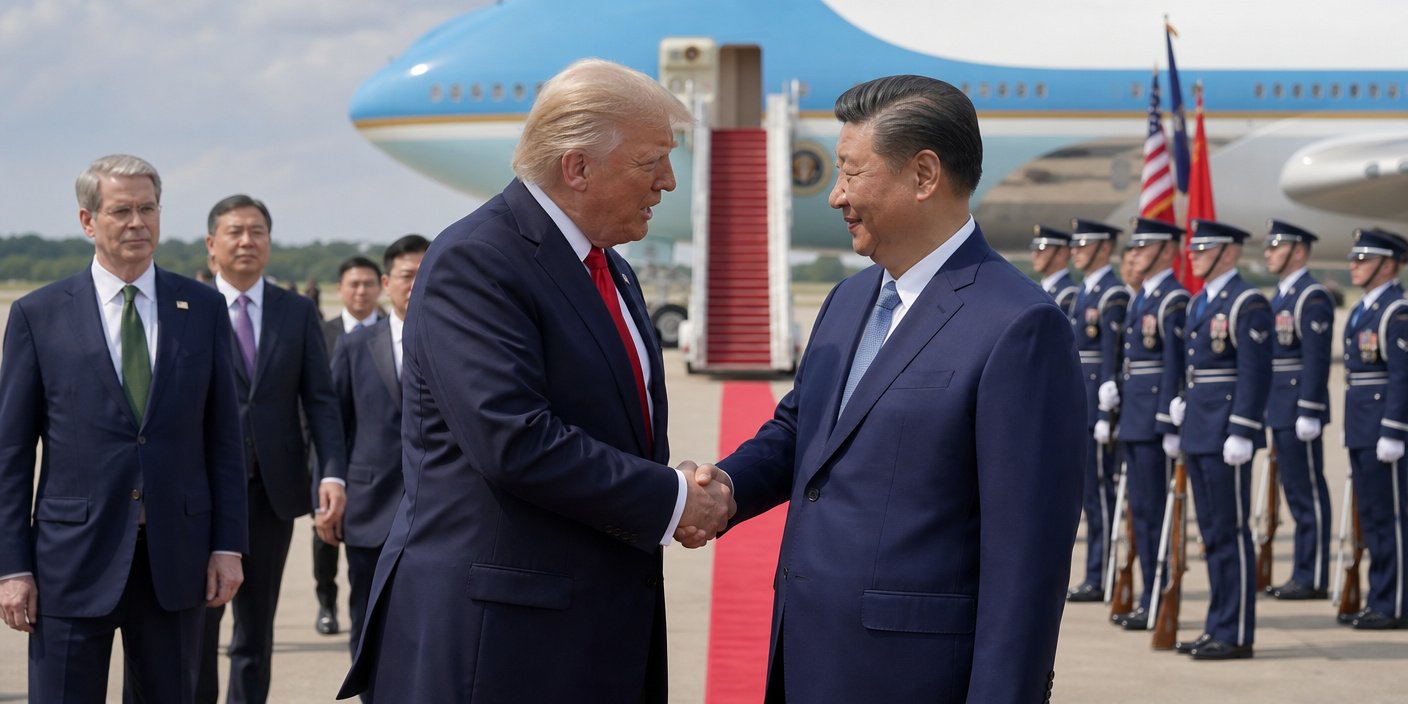
Xi Jinping has cautioned Donald Trump that mishandling the issue of Taiwan could lead to conflict, underscoring the high stakes in U.S.-China relations.
Key Highlights:
- Xi Jinping issued a direct warning to Donald Trump regarding the potential for conflict over Taiwan.
- The Chinese President emphasized the sensitivity and critical nature of the Taiwan issue.
- The exchange highlights the ongoing geopolitical tensions between the U.S. and China.
- Trump’s past policies and statements on Taiwan have been a point of contention.
Geopolitical Tensions Flare: Xi Jinping’s Taiwan Warning to Trump
In a stark message to former U.S. President Donald Trump, Chinese President Xi Jinping has warned that mishandling the issue of Taiwan could spark “conflicts.” This direct communication, reportedly conveyed during a private interaction, underscores the intensely sensitive nature of Taiwan in U.S.-China relations and the potential ramifications of shifting geopolitical dynamics. The warning highlights Beijing’s long-standing assertion that Taiwan is an inalienable part of China and its determination to prevent any actions that could be perceived as supporting Taiwanese independence.
The Significance of Taiwan in U.S.-China Relations
Taiwan, officially the Republic of China (ROC), has been a central and increasingly volatile point of contention since the Chinese Civil War concluded in 1949. The People’s Republic of China (PRC) views Taiwan as a renegade province that must be reunified with the mainland, by force if necessary. The United States, while acknowledging the PRC’s One China principle, maintains a complex relationship with Taiwan, providing it with defensive capabilities under the Taiwan Relations Act. This policy of “strategic ambiguity” has long been a cornerstone of U.S. foreign policy in the region, aiming to deter both a Chinese invasion and a Taiwanese declaration of independence.
Trump’s Previous Stance and Beijing’s Concerns


Donald Trump’s presidency saw significant shifts in U.S. foreign policy, including a more confrontational approach towards China on trade and other issues. Notably, in 2016, shortly after winning the election, Trump broke with decades of U.S. diplomatic precedent by speaking directly with Taiwanese President Tsai Ing-wen. This move was seen by Beijing as a major provocation. Throughout his term, Trump’s administration increased arms sales to Taiwan and engaged in more frequent naval transits through the Taiwan Strait, actions that consistently drew strong condemnation from Beijing. Xi Jinping’s reported warning to Trump indicates that Beijing remains deeply concerned about the potential for a future Trump presidency to adopt similarly disruptive policies, which could escalate tensions to a dangerous level.
The “One China” Principle and its Global Implications
The “One China” principle is a fundamental tenet of China’s foreign policy and its relationship with other nations. It posits that there is only one sovereign state under the name China, and that the government of the People’s Republic of China is the sole legitimate government of that China. While most countries, including the United States, officially recognize the PRC, many maintain unofficial relations with Taiwan. The principle is fiercely defended by Beijing, and any perceived challenge to it, such as official diplomatic recognition of Taiwan or significant military support, is met with severe disapproval and potential retaliation. The stability of the Indo-Pacific region hinges significantly on the careful navigation of this principle by global powers.
Economic and Military Ramifications of Conflict
Any conflict over Taiwan would have devastating global economic and military consequences. Taiwan is a critical hub in the global supply chain, particularly for advanced semiconductors. Companies like Taiwan Semiconductor Manufacturing Company (TSMC) produce the vast majority of the world’s most sophisticated chips, essential for everything from smartphones and computers to advanced military equipment. A disruption to this supply would cripple industries worldwide. Militarily, a conflict involving China and potentially the United States would be catastrophic, drawing in regional allies and potentially leading to a wider conflagration. The economic interdependence of the region, coupled with the military might of the involved powers, makes a Taiwan conflict an outcome that most international actors desperately seek to avoid.
Secondary Angles:
- Historical Context: Examining the historical roots of the cross-strait division, including the Chinese Civil War and the subsequent U.S. involvement in the region.
- Economic Interdependence: Analyzing the profound global economic reliance on Taiwan, especially for semiconductor manufacturing, and the potential fallout of any conflict.
- Future U.S. Policy: Speculating on how future U.S. administrations might navigate the complex Taiwan issue and the implications for regional stability.
FAQ: People Also Ask
What is the “One China” policy?
The “One China” policy is a diplomatic stance, primarily held by the People’s Republic of China (PRC), asserting that there is only one sovereign state under the name China, and that the PRC government is the sole legitimate government of that China. The United States officially “acknowledges” the PRC’s position but maintains its own interpretation, allowing for unofficial relations with Taiwan and providing for its defense.
Why is Taiwan so important to China?
Taiwan is considered by the PRC to be a renegade province that must be reunified with the mainland. Its strategic location in the First Island Chain is also of significant geopolitical and military importance to China’s regional ambitions and its ability to project power into the Pacific Ocean.
What did Xi warn Trump about specifically?
Reports indicate that Xi Jinping warned Donald Trump that mishandling the issue of Taiwan could lead to “conflicts.” This suggests Beijing’s concern that Trump’s past actions and potential future policies could destabilize the delicate balance concerning Taiwan.
What is the current U.S. stance on Taiwan?
The current U.S. stance is one of “strategic ambiguity.” While the U.S. acknowledges the PRC’s “One China” principle, it does not explicitly state whether it would intervene militarily if China attacked Taiwan. However, the U.S. does sell defensive arms to Taiwan and maintains strong unofficial ties.
What are the economic implications of a Taiwan conflict?
A conflict involving Taiwan would have severe global economic consequences, particularly due to Taiwan’s dominant role in semiconductor manufacturing. The disruption of this vital supply chain could cripple numerous industries worldwide, leading to shortages and economic recession.