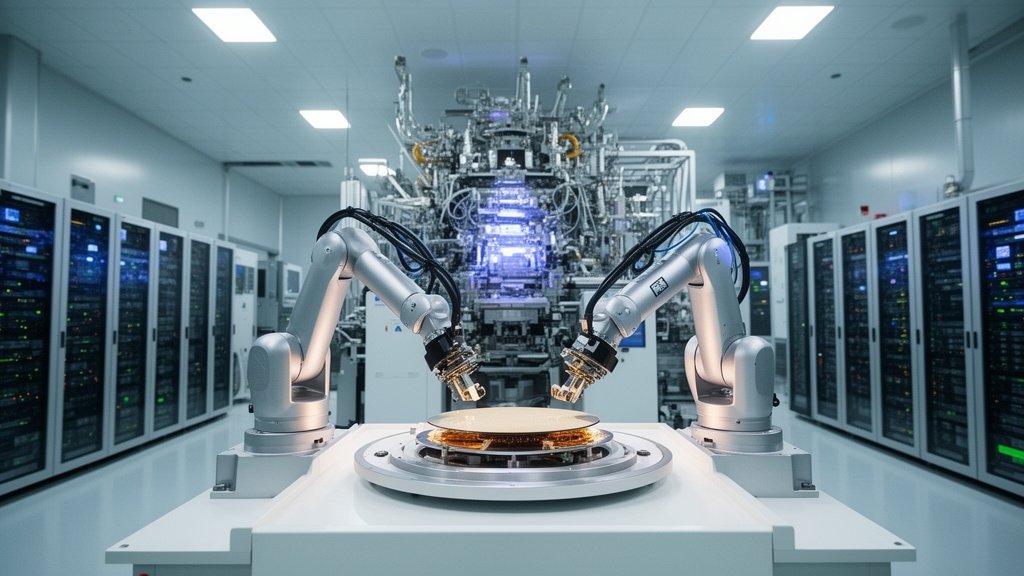
Philadelphia, PA – In a potential paradigm shift for the electronics industry, researchers at Penn State have successfully constructed the world’s first functioning computer built entirely from atom-thin two-dimensional (2D) materials. This groundbreaking achievement, detailed in the prestigious journal Nature on June 11, 2025, and publicly reported on June 12, 2025, represents a significant challenge to silicon’s decades-long dominance in computing technology.
For years, scientists have explored alternatives to silicon as the fundamental building block of electronic components, seeking materials that could offer enhanced performance, efficiency, or scalability. Two-dimensional materials, celebrated for their remarkable electronic and physical properties at the atomic scale, have emerged as promising candidates. This new development marks the first time these materials have been integrated into a fully functional computing system.
A New Foundation for Computing
The Penn State team’s breakthrough hinges on the strategic use of specific 2D materials for complementary metal-oxide-semiconductor (CMOS) logic circuits, the fundamental technology underpinning virtually all modern digital electronics. Unlike traditional silicon-based CMOS, which relies on differently doped silicon regions to create n-type and p-type transistors, the researchers utilized distinct 2D materials.




Specifically, the computer employs molybdenum disulfide (MoS2) for its n-type transistors and tungsten diselenide (WSe2) for its p-type transistors. This combination allows for the creation of integrated circuits necessary for complex logic operations. MoS2 and WSe2 were selected due to their unique electronic characteristics that are complementary, much like the n-type and p-type silicon components in conventional CMOS.
Engineering an Atom-Thin Processor
The fabricated 2D-material computer is not merely a theoretical concept or a simple demonstration circuit. It contains over 2,000 transistors and is fully capable of executing simple logic operations, proving the viability of 2D materials for complex digital processing. While not yet competing with the speed or complexity of modern silicon processors, its mere existence represents a crucial milestone.
Performance metrics for the prototype demonstrate impressive efficiency for such nascent technology. The system operates at a supply voltage of less than 3 volts and achieves frequencies up to 25 kilohertz. Critically, its power consumption is remarkably low, measured in the picowatt range, and the switching energy for CMOS inversion is approximately 100 picojoules. These figures hint at the potential for extremely energy-efficient computing in future iterations.
The Manufacturing Innovation
The successful construction of this device was made possible by advancements in material growth and fabrication techniques. The team, led by Saptarshi Das, Professor of Engineering Science and Mechanics at Penn State, leveraged state-of-the-art methods to produce the necessary 2D material layers.
The researchers utilized metal-organic chemical vapor deposition (MOCVD), a technique capable of growing large, high-quality sheets of 2D materials, ensuring consistency and scalability needed for integrated circuit fabrication. This critical work was conducted at the 2D Crystal Consortium Materials Innovation Platform (2DCC-MIP), a national user facility at Penn State dedicated to advancing the science and technology of 2D materials. The ability to grow large-area 2D films via MOCVD was a key factor in overcoming previous manufacturing challenges that limited the size and complexity of 2D material circuits.
Support and Future Implications
The research received substantial support from key governmental agencies, including the Office of Naval Research, the Army Research Office, and the U.S. National Science Foundation. This funding underscores the strategic importance placed on exploring post-silicon computing technologies for defense, industry, and fundamental research.
The development of the world’s first 2D-material computer opens numerous avenues for future exploration. While significant challenges remain in scaling up the technology, increasing performance, and refining manufacturing processes, this achievement validates the potential of atom-thin materials to form the basis of next-generation electronic devices. Applications could range from ultra-low-power flexible electronics and wearable technology to novel computing architectures that exploit the unique properties of 2D materials.
This landmark demonstration by the Penn State team serves as compelling evidence that the future of computing may not be exclusively silicon-based, potentially ushering in an era defined by materials just atoms thick.