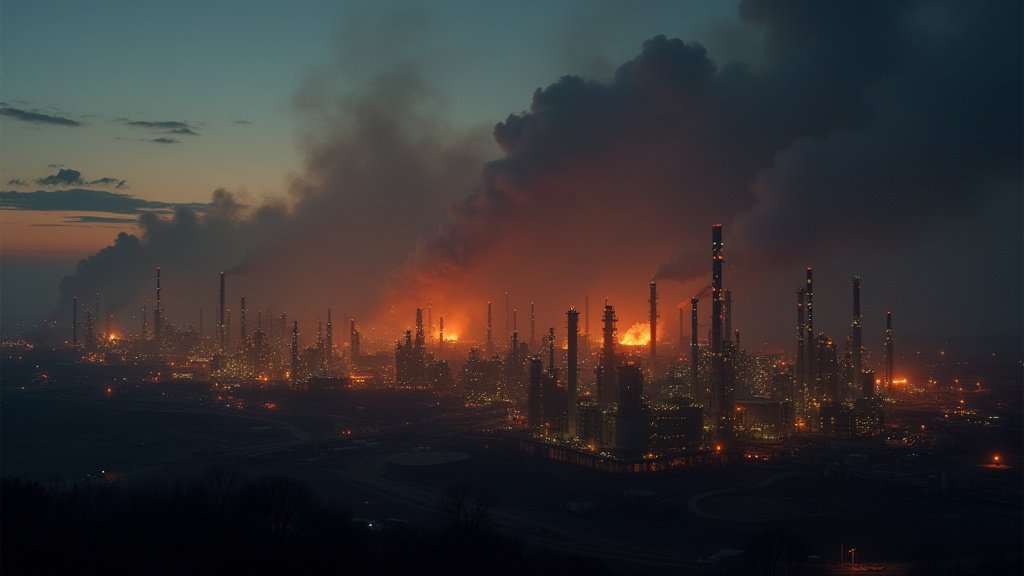
President Donald Trump has issued a stark 48-hour ultimatum to Iran, demanding the complete and unhindered reopening of the Strait of Hormuz. Failure to comply, Trump stated via social media, would result in the United States “hit[ting] and obliterate[ing] their various POWER PLANTS, STARTING WITH THE BIGGEST ONE FIRST!” This aggressive posture underscores the escalating tensions in the Middle East, with the conflict now in its fourth week. The disruption of the Strait of Hormuz, a vital chokepoint for approximately one-fifth of global oil and liquefied natural gas supplies, has already sent European gas prices soaring by as much as 35 percent.


Trump’s demands have placed significant pressure on NATO allies, whom he has sharply criticized for their reluctance to provide military support in securing the waterway. He has gone as far as to label NATO members “cowards” and “paper tigers,” expressing disappointment that the alliance has declined to participate in military operations despite supporting Washington’s broader position on Iran. Trump argued that the U.S. has invested trillions in supporting NATO and expects reciprocity, especially when vital global interests like the Strait of Hormuz are at stake. He even suggested that NATO’s refusal to assist was a “very foolish mistake” and a “great test” for the alliance, implying that the U.S. might reassess its commitment if allies do not provide the requested support. The President also threatened to delay a planned summit with Chinese leader Xi Jinping if Beijing does not assist in reopening the strait.
Allies Resist and Offer Cautious Responses
The response from NATO allies and other international partners has been largely cautious, with many expressing a preference for de-escalation and diplomatic solutions. European leaders, in particular, have voiced concerns about becoming directly entangled in the conflict, which they often describe as a “war of choice” initiated by the U.S. and Israel without prior consultation. French President Emmanuel Macron stated that France would “never” participate in operations to reopen the Strait of Hormuz as long as the situation remains volatile, suggesting that any mission would need to be separate from the ongoing hostilities and diplomatically coordinated. Similarly, other European nations, including Austria, have declared that intervention in the Strait of Hormuz is “not an option.”
While some countries, such as Germany, France, the UK, Italy, the Netherlands, and Japan, initially indicated a willingness to assist in securing the waterway, three of these countries later clarified they would only help after a ceasefire is reached. Japan’s defense minister has stated that Tokyo has no plans to send ships and called for de-escalation. The U.S. military buildup in the region continues, with additional warships and thousands of Marines being deployed to the Middle East, however, the effectiveness of these deployments in pressuring Iran without broader international support remains a key question.
Iran’s Retaliation and Diplomatic Denials
Iran has responded to the escalating pressure by warning that it would strike all U.S. and Israeli energy, information technology, and desalination infrastructure across the region if its own facilities come under attack. Iranian Foreign Minister Abbas Araghchi has pushed back against claims that Iran has closed the strait, suggesting that ships are hesitating due to insurance fears stemming from the “war of choice” initiated by the U.S. and Israel, rather than a deliberate blockade by Tehran. Araghchi also urged neighboring countries to “expel foreign aggressors” and refrain from actions that could lead to further escalation.
President Trump, however, has maintained a contrasting view, telling NBC News that he believes Tehran is eager to negotiate, though he is unwilling to accept terms he deems insufficient. Araghchi, in interviews with U.S. networks, has denied that Tehran is seeking an agreement, stating that Iran is “stable and strong enough” and sees no reason to engage in talks with the Americans, especially given the ongoing conflict. The ongoing conflict, which began on February 28th, has reportedly resulted in a significant number of casualties, including the death of Iran’s Supreme Leader Ayatollah Ali Khamenei. Iran has retaliated with drone and missile strikes targeting Israel, Jordan, and Gulf countries with U.S. military assets.