The landscape of the US Minimum Wage remains complex as 2025 unfolds, with the federal minimum wage holding at $7.25 per hour, a rate unchanged since 2009. While federal action on a broad US Minimum Wage increase remains stalled, a significant number of states are implementing their own adjustments, creating a patchwork of pay rates that vary widely across the country. These state-level changes reflect a growing trend towards higher minimums, often driven by inflation and the rising cost of living impacting American workers. The US Minimum Wage is a critical economic indicator for many households, and understanding the nuances of the federal minimum wage versus the state minimum wage is essential.
The Federal Minimum Wage: A Lingering Stalemate on the US Minimum Wage

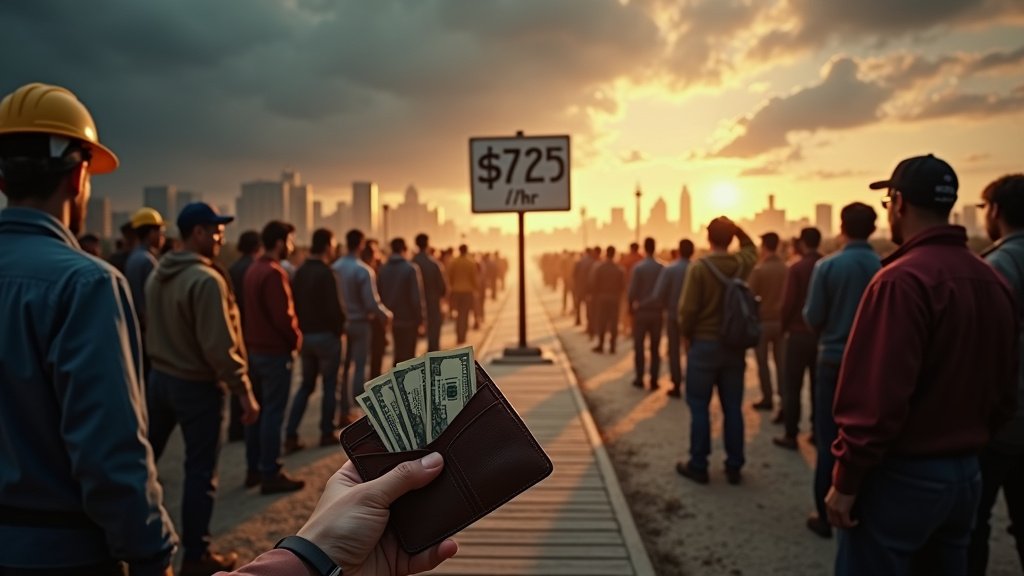


The federal minimum wage, established by the Fair Labor Standards Act (FLSA), has been $7.25 per hour for over fifteen years. Unlike many state minimum wages, the federal rate is not automatically adjusted for inflation, requiring an act of Congress to enact any changes to the US Minimum Wage. Proposed legislation, such as the ‘Raise the Wage Act,’ has aimed to gradually increase the federal minimum to $15 or higher by 2025 and beyond, but these bills have not become law. Consequently, millions of American workers in states that follow the federal rate continue to earn wages that fall below what many consider a living wage. Understanding the current US Minimum Wage is crucial for both employers and employees, especially when comparing it to the rising cost of living.
States Lead the Charge in Wage Increases for the US Minimum Wage
In contrast to the federal stasis, numerous states and local jurisdictions have enacted their own minimum wage laws, many of which exceed the federal floor. As of 2025, more than 20 states are experiencing wage increases, demonstrating a proactive approach to the US Minimum Wage. These adjustments are often phased in over several years or tied to inflation, ensuring that wages attempt to keep pace with economic realities. This has led to a varied state minimum wage across the nation.
For instance, Florida is scheduled to raise its minimum wage to $14.00 per hour for non-tipped workers on October 30, 2025, as part of a multi-year plan to improve the US Minimum Wage. Other states continue to see significant hourly rates: Washington state’s minimum wage stands at $16.66 per hour for 2025, with a further increase projected for 2026. Similarly, Washington D.C. had a minimum wage of $17.00 per hour as of January 2025. Many other states, including California, New York, and Illinois, have set their minimum wages considerably higher than the federal level, with rates often ranging from $15.00 to over $17.00 per hour in 2025. This divergence means that an ‘American worker’ can experience vastly different earning potentials depending solely on their geographic location, impacting their personal US Minimum Wage experience.
Economic Ripples and Trending Stories on US Minimum Wage
The varying minimum wage rates have a profound impact on businesses and employees. For workers, higher minimum wages can lead to increased purchasing power, potentially lifting families out of poverty and boosting consumer spending. The average annual pay increase for affected workers could amount to thousands of dollars, transforming the financial stability for many. Stories are emerging across various sectors about how these wage adjustments are helping employees manage rising costs for essentials like rent, food, and healthcare, often exceeding the baseline US Minimum Wage. The concept of a living wage is increasingly being discussed alongside the state minimum wage.
However, businesses, particularly small and medium-sized ones, may face increased labor costs. Some companies are exploring strategies such as adjusting prices, optimizing operations, or re-evaluating staffing models to absorb these changes. Economic experts debate the broader effects, with some predicting GDP growth due to increased demand, while others caution about potential price inflation if businesses pass on increased costs to consumers. The Congressional Budget Office has previously estimated that a substantial federal minimum wage hike could impact employment figures, though research on past increases shows mixed results, with many studies finding small to negligible effects on employment, a constant discussion point surrounding the US Minimum Wage.
A Shifting Minimum Wage Landscape and the US Minimum Wage
As 2025 progresses, the minimum wage debate continues to be a trending topic. The disparity between the stagnant federal rate and the dynamic state-level increases highlights an ongoing effort to define a ‘living wage’ for American workers. While the federal government has not introduced a broad increase to the US Minimum Wage, the momentum at the state level suggests a clear direction towards higher pay floors, shaping economic stories and impacting millions across the nation. Foreign missions in the U.S. are also reminded of their obligation to comply with these evolving federal, state, and local minimum wage laws, further underscoring the importance of the US Minimum Wage.