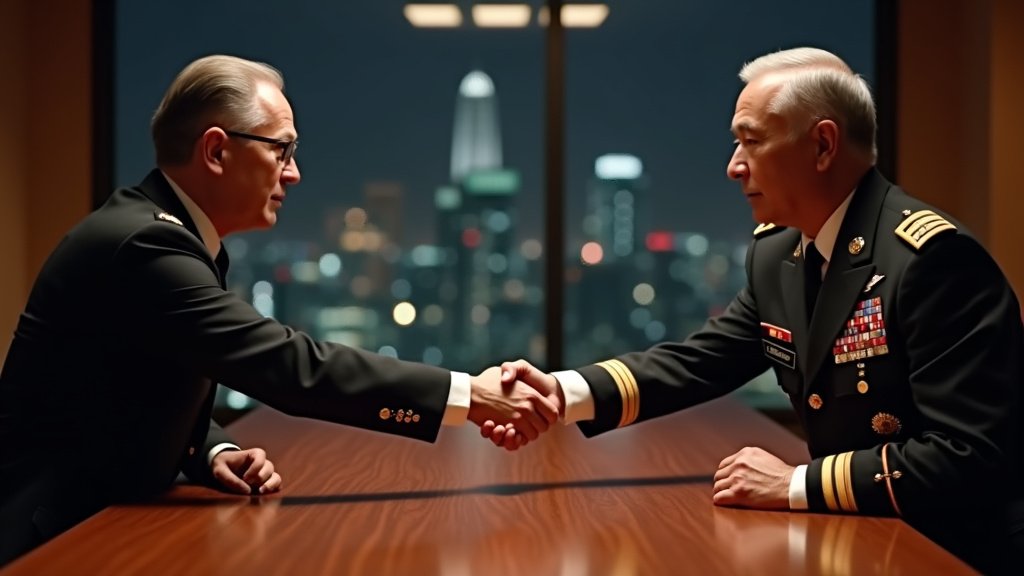
U.S. Defense Secretary Pete Hegseth announced on Sunday, November 2, 2025, that the United States and China have agreed to establish direct US China Military Communication channels. This significant development follows a series of high-level engagements, including a meeting between U.S. President Donald Trump and Chinese President Xi Jinping in South Korea and a subsequent discussion between Hegseth and his Chinese counterpart, Admiral Dong Jun, in Malaysia. Hegseth described the bilateral ties as “never been better” and stated that both he and Admiral Dong Jun agreed that “peace, stability, and good relations are the best path for our two great and strong countries.” This agreement marks a crucial step towards de-escalation and aims to prevent misunderstandings that could lead to conflict, a concern that has long been voiced by experts in US China Military Communication.
Background to the Agreement on US China Military Communication
The establishment of these direct military communication channels comes after a period of significant tension and limited dialogue between the U.S. and China, impacting US China relations. For years, experts have underscored the necessity of such direct contacts to avert accidental military clashes, particularly given the increasing operational proximity of their navies in the Asia Pacific. During President Trump’s first term, many communication links between the two governments went dormant, and China further cut off remaining channels in 2022 following then-U.S. House Speaker Nancy Pelosi’s visit to Taiwan. This breakdown in communication coincided with dangerous encounters in the South China Sea and Taiwan Strait, underscoring the fragility of US China Military Communication. The recent engagement between President Trump and President Xi Jinping in South Korea is seen as a pivotal moment, setting a positive tone for renewed diplomatic efforts. This summit led to several outcomes, including a reduction in U.S. tariffs on Chinese goods and agreements on trade and resource management. The meeting between Hegseth and Dong Jun in Malaysia built upon this momentum, leading to the agreement on restoring military communication lines, a key aspect of US China diplomacy.
Implications for Regional Stability and US China Military Communication
The establishment of direct military communication channels is expected to have significant implications for regional and global security, particularly concerning US China Military Communication. It provides a crucial mechanism for deconfliction and de-escalation, a vital de-escalation strategy, particularly in volatile areas such as the South China Sea and the Taiwan Strait. These regions have been flashpoints for U.S.-China tensions, with incidents involving naval vessels and aircraft highlighting the risks of miscalculation and the critical need for effective US China Military Communication. Admiral Dong Jun, while meeting with Hegseth, emphasized the importance of building trust and strengthening policy-level dialogue to enhance understanding and dispel uncertainty. He reiterated China’s stance on Taiwan, calling the “unification of the two sides of the Taiwan Strait an irresistible historical trend” and urged the U.S. to be cautious in its words and deeds concerning the issue. This highlights the ongoing strategic differences that persist despite the agreement to enhance US China Military Communication. U.S. Defense Secretary Hegseth, prior to this announcement, had urged Southeast Asian nations to bolster their maritime forces to counter China’s assertive actions in the South China Sea, citing China’s territorial claims as contrary to peaceful dispute resolution. He also stressed the importance of maintaining a balance of power in the Indo-Pacific and reaffirmed the U.S. commitment to defending its interests in the region, all within the broader context of US China Military Communication.
Moving Forward: A Path of Dialogue and Caution in US China Military Communication
Officials from both countries will hold further discussions to finalize the specifics of the proposed communication mechanisms. While the agreement signals a positive step towards managing tensions and fostering stability in Asia Pacific security, analysts caution that fundamental strategic differences remain. The successful implementation of these communication channels, specifically through improved US China Military Communication, will be critical in preventing competition from escalating into conflict, a persistent concern in the complex US China relations. This development offers a glimmer of hope for more predictable interactions amidst the ongoing global security challenges and trending stories about great power dynamics. The American approach, characterized by both deterrence and diplomacy, aims to ensure that the world’s two largest military powers can navigate their relationship constructively, with enhanced US China Military Communication as a cornerstone. This effort to re-establish direct military communication channels is a noteworthy part of current American foreign policy narratives regarding China, aiming to manage a critical bilateral relationship through dialogue and robust US China Military Communication.