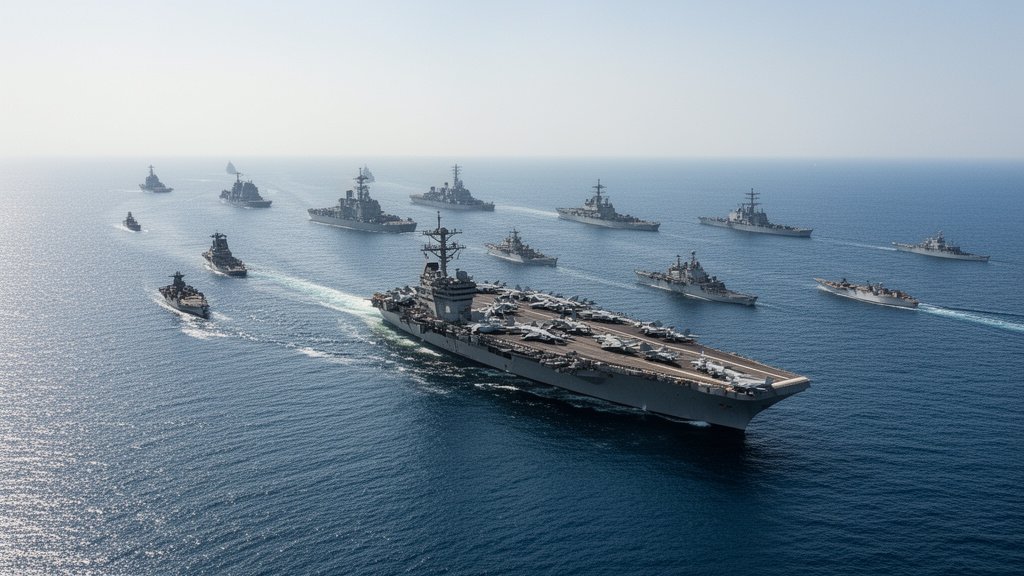
President Donald Trump has issued a significant foreign policy update regarding the United States’ posture toward Iran, confirming that the U.S. will not attack Iran before the November 3 midterm elections. The announcement, delivered via official social media channels, serves as a high-stakes pivot point for U.S. geopolitical strategy in the Middle East. By explicitly removing the option of direct military engagement from the pre-election window, the administration is attempting to manage the optics of foreign conflict during a critical domestic political cycle while emphasizing the continuation of a strict, ongoing blockade.
Key Highlights
- No Pre-Election Conflict: The administration has formally stated that no military strikes against Iran are planned prior to the November 3 midterm elections.
- Diplomatic Channels: President Trump cited “productive discussions” as the primary rationale for the strategic pause in military posturing.
- Blockade Remains Active: While military action is off the table, the U.S. maintains its existing blockade, ensuring that economic and logistical pressure on the Iranian state continues unabated.
The Strategic Pivot: Balancing Diplomacy and Containment
President Trump’s declaration marks a decisive moment in the ongoing US-Iran relationship, shifting the immediate focus from potential escalation to a managed diplomatic stance. This decision is not merely a cessation of threats but a calculated alignment of international pressure and domestic timing. By telegraphing this decision, the administration provides a level of clarity that, while unexpected in traditional foreign policy doctrine, functions as a mechanism to stabilize global energy markets and reduce the volatility that typically accompanies talk of military intervention in the Persian Gulf.
The Anatomy of “Productive Discussions”


The phrase “productive discussions” serves as the centerpiece of this administration’s current diplomatic pivot. While details regarding the nature of these communications—or the intermediaries facilitating them—remain classified, the rhetoric marks a stark contrast to the bellicose posturing often associated with the region. This approach suggests that there are back-channel negotiations, potentially involving regional allies or international entities, aimed at de-escalating the immediate threat of kinetic conflict. Analysts suggest that by publicly validating these discussions, the White House is signaling to the international community that the current strategy is one of ‘contained diplomacy’ rather than isolationist aggression.
However, it is crucial to recognize that these discussions are occurring under the shadow of a persistent blockade. This duality is the hallmark of the current administration’s approach to global adversaries: utilizing economic strangulation and logistical restriction to force a hand, while maintaining open lines of communication to prevent the conflict from devolving into an uncontrollable military engagement. The success of this strategy rests on the assumption that the Iranian leadership views the blockade as a challenge that must be negotiated with, rather than a provocation that requires military retaliation.
Economic Calculus and Global Markets
The impact of this announcement on global energy markets cannot be overstated. The threat of U.S. military intervention in the Persian Gulf is historically one of the most significant ‘risk premiums’ affecting crude oil prices. By officially removing the threat of a strike before November 3, President Trump has effectively tempered one of the primary drivers of market anxiety. Traders and global stakeholders now have a specific date-bound horizon, allowing for more stable short-term economic planning. If the blockade continues to function without escalating into a hot war, market volatility is expected to stabilize, providing a predictable environment for energy commodities that are heavily influenced by Iranian output levels.
Domestic Implications of Foreign Policy
The timing of this announcement, closely tied to the November 3 midterm elections, underscores the inextricable link between domestic politics and international security. Political observers note that an unexpected military conflict just weeks before an election introduces an ‘October Surprise’ variable that can be as damaging as it is unpredictable. By taking the possibility of a conflict off the table, the administration is likely seeking to neutralize foreign policy as a disruptive factor in the midterm campaign, allowing the focus to return to domestic issues such as the economy, healthcare, and voter turnout. This is a classic example of ‘clearing the deck’—a strategic move to eliminate external risks that could fracture the party’s message during the final stretch of the election cycle.
FAQ: People Also Ask
Q: Does this announcement signify a permanent end to military tension with Iran?
A: No. The administration has limited this non-aggression stance to the period leading up to the November 3 midterm elections. It does not establish a long-term framework for peace, nor does it preclude future military action once the political landscape has shifted.
Q: How does the blockade affect the ‘productive discussions’ mentioned by the President?
*A: The blockade functions as the ‘stick’ to the ‘carrot’ of these discussions. It maintains pressure on the Iranian economy and political structure, incentivizing Tehran to remain engaged in the dialogue rather than walking away or escalating regional tensions.
Q: What is the primary risk of this public announcement?
*A: By setting a date-bound expectation of non-intervention, the administration risks emboldening the adversary. If Iran interprets this announcement as a window of immunity, they might increase regional activities that could force the U.S. to choose between credibility and the promise not to strike.