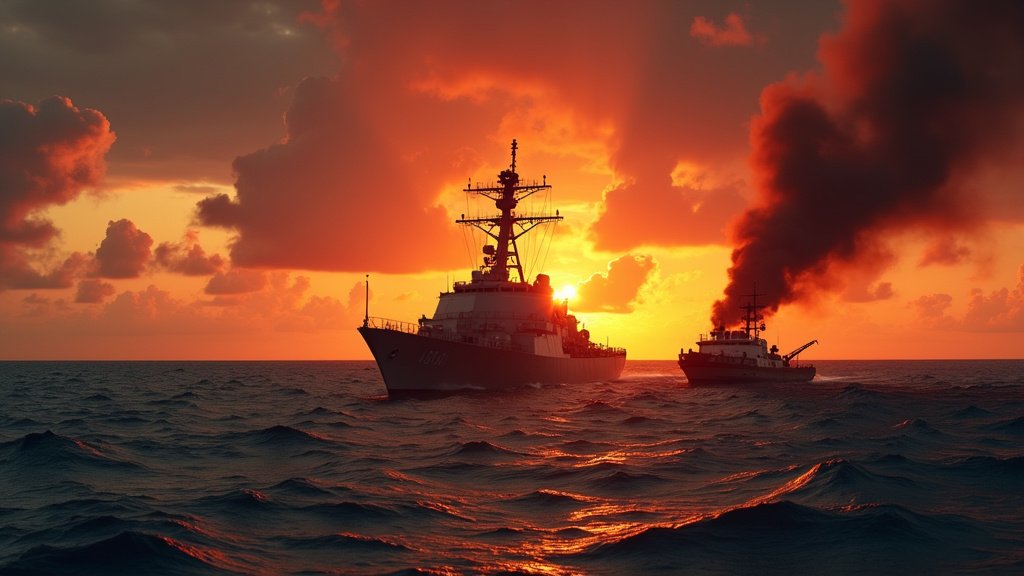
The Islamic Revolutionary Guard Corps (IRGC) Navy has officially confirmed that three oil tankers were struck by naval mines while navigating the Strait of Hormuz on Monday, resulting in significant fires aboard the vessels. The incident marks a severe escalation in the region, with the IRGC asserting that U.S. military air cover, stationed in the vicinity, was unable to intervene or prevent the targeted attacks. This development has sent immediate shockwaves through global energy markets, heightening concerns over the security of one of the world’s most critical maritime chokepoints.
Key Highlights
- Confirmed Mine Strikes: The IRGC Navy reports three distinct oil tankers have been disabled by naval mine blasts within the Strait of Hormuz.
- Failed U.S. Intervention: Official IRGC statements claim that despite the presence of U.S. military air support in the region, the assets were unable to mitigate the threat or prevent the explosions.
- Regional Destabilization: The incident represents a significant spike in tensions, threatening to impact global crude oil supply chains and shipping insurance premiums.
Escalation in the Persian Gulf: The Hormuz Standoff
The Strait of Hormuz, a narrow waterway connecting the Persian Gulf with the Gulf of Oman and the Arabian Sea, serves as the primary artery for approximately 20 to 30 percent of the world’s total oil consumption. The IRGC’s announcement regarding the mine strikes highlights the vulnerability of commercial shipping in this contested corridor. By explicitly stating that U.S. military assets were present but ineffective, the IRGC is positioning the event not just as a tactical success, but as a strategic demonstration of their operational reach in the face of international naval presence.
The Mechanics of the Threat
Naval mines remain one of the most effective and low-cost asymmetrical warfare tools available to regional actors. Unlike missiles, which require complex guidance systems and tracking, mines are passive, lethal, and difficult to clear. The use of such weaponry against commercial oil tankers creates an environment of pervasive fear for commercial maritime insurers.
When a commercial vessel is struck by a mine, the immediate aftermath involves not only the physical danger of fire and structural damage but also a massive surge in war-risk insurance premiums for all vessels operating in the region. This ‘insurance shock’ functions as an economic weapon, effectively slowing down global trade even if the physical damage is contained to specific vessels. The IRGC’s ability to deploy these assets successfully, while bypassing local maritime security, indicates a sophisticated understanding of how to disrupt the global flow of energy without engaging in a conventional, full-scale naval battle that the U.S. might dominate.
The Geopolitical Impasse
This incident forces a complex diplomatic and military recalculation. The U.S. Central Command (CENTCOM), which maintains a significant footprint in the Persian Gulf to ensure the ‘freedom of navigation,’ faces a critical dilemma. If they are perceived as unable to protect civilian shipping, the perceived security guarantee of the U.S. presence is diminished. Conversely, if they respond with force, they risk a broader, kinetic conflict that could close the Strait entirely.
Historically, the U.S. has maintained that keeping the Strait of Hormuz open is a vital national security interest. The IRGC’s assertion that they successfully executed these attacks under the watch of U.S. air cover serves as a direct challenge to this doctrine. Analysts are now closely monitoring whether this will lead to a surge in international naval coalition deployments or a push for diplomatic backchannel negotiations to de-escalate the situation before the market reaction forces oil prices into a volatile spiral.
Economic Vulnerabilities and Global Supply Chains
Beyond the military posturing, the global energy economy is highly sensitive to disruption in the Strait. Even a temporary blockage or a sustained period of ‘mine warfare’ creates a localized scarcity premium. With major economies still navigating post-pandemic recovery and inflationary pressures, any prolonged uncertainty regarding the safety of tankers in the Persian Gulf will likely force energy futures to react aggressively.
Industry experts note that commercial shipping companies often adopt a ‘wait and see’ approach following such announcements, leading to delays in cargo loading and transit. If the IRGC’s claim of successful, unopposed strikes continues to be verified by incoming reports, we may see a significant increase in the presence of private security details aboard commercial tankers, further complicating the legal and operational landscape of international shipping.
FAQ: People Also Ask
Q: What is the significance of the Strait of Hormuz in global trade?
A: It is the world’s most important oil chokepoint. Every day, roughly 21 million barrels of oil transit through the narrow passage, which is vital for the global economy.
Q: How do naval mines differ from other maritime threats?
A: Naval mines are ‘passive’ threats. They are inexpensive to manufacture and deploy, yet they pose a catastrophic risk to large, slow-moving oil tankers, which have little in the way of defensive armor or counter-measures against underwater explosive devices.
Q: How does the IRGC’s claim of ‘failed U.S. intervention’ change the situation?
A: It shifts the narrative from a mere accident or local skirmish to a direct challenge of U.S. naval capability. It is intended to project power and suggests that the IRGC can act with a degree of impunity in their regional waters.
Q: What are the likely next steps for commercial shipping?
A: Shipping companies will likely demand higher security escorts, divert routes (if possible), or face significantly higher insurance ‘war risk’ premiums, which will eventually be passed on to consumers in the form of higher fuel and energy costs.