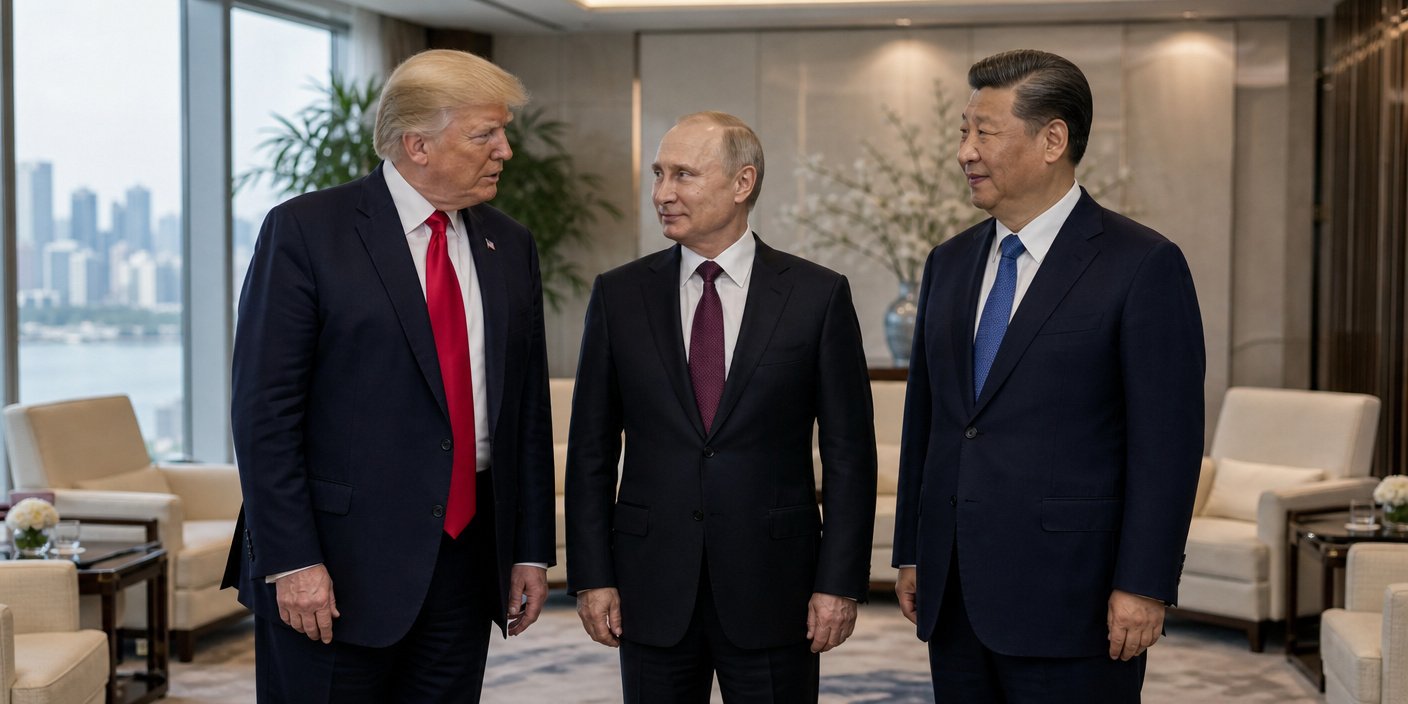
The APEC summit in Shenzhen has concluded as a watershed moment in 21st-century diplomacy, marked by an unprecedented trilateral meeting between U.S. President Donald Trump, Russian President Vladimir Putin, and Chinese President Xi Jinping. This high-stakes encounter, occurring in the shadow of shifting U.S. domestic political outcomes, has crystallized a transition from a unipolar international order to a complex, multipolar reality where the traditional leverage of the United States faces significant challenges from a solidified Russian-Chinese axis.
Key Highlights
- Unprecedented Trilateral Format: The meeting marks a rare, direct diplomatic engagement between the three global superpowers, fundamentally altering the traditional APEC format.
- Shift in Global Dynamics: The optics of the summit reflect a decisive pivot in influence, with analysts observing a diminished American negotiation position following recent U.S. election results.
- Economic and Strategic Realignment: Discussions centered on trade corridors, Pacific-Rim security protocols, and the re-evaluation of global alliances in a post-hegemonic era.
The Shenzhen Summit: A New Tri-Polar Order
The selection of Shenzhen as the host city for this summit is, in itself, a testament to the shifting center of gravity in the global economy. As a sprawling technological hub and a symbol of China’s modernization, Shenzhen served as the backdrop for a meeting that many diplomatic observers are labeling the most significant geopolitical adjustment of the decade. The trilateral engagement between President Donald Trump, President Vladimir Putin, and President Xi Jinping was not merely a ceremonial interaction but a granular negotiation that highlighted the vulnerabilities inherent in the current American political climate.
The Optics of a Diminished American Mandate
Political capital is the currency of international diplomacy, and the atmosphere in Shenzhen was thick with the awareness of the recent U.S. election results. For President Trump, the summit presented the unique challenge of navigating high-level negotiations while contending with a domestic political landscape characterized by uncertainty.
Analysts have noted that the “weakened” positioning mentioned in diplomatic circles stems from the internal legislative gridlock and the perception of a polarized American electorate, which has arguably emboldened counterparts in the room. When the U.S. President arrived at the summit, the traditional deference typically afforded to American leadership was replaced by a more scrutinizing, calculating gaze from the Russian and Chinese delegations. This shift is not merely cosmetic; it changes the nature of the deals on the table, as Xi and Putin appeared to operate with a level of synchronization that suggests a deep, pre-existing bilateral understanding, effectively squeezing the American negotiating space.
Analyzing the Xi-Putin Synergy



The most striking development observed during the summit was the apparent synergy between President Xi and President Putin. Their body language, the coordinated messaging regarding Pacific trade lanes, and their mutual emphasis on multipolarity served as a unified counter-narrative to American-led globalization. For years, the U.S. diplomatic strategy relied on playing regional powers against one another; however, the Shenzhen summit suggests that this strategy may be suffering from diminishing returns.
Russia, bolstered by its energy exports, and China, anchored by its manufacturing dominance, presented a cohesive front. They were not merely reacting to U.S. policy but were actively drafting the agenda. For the American delegation, this forced a transition from a position of dictating terms to one of reactive crisis management. The discussions regarding tariffs, semiconductor supply chains, and territorial maritime rights were framed through a lens that prioritized the Asian-Pacific and Eurasian interests over transatlantic expectations.
Future Implications for Global Hegemony
The ramifications of this summit will ripple through global markets and defense strategies for years to come. If the United States can no longer rely on the sheer weight of its executive mandate to influence international outcomes, the global community will likely see a surge in regional alignments.
This summit marks a potential turning point where the “American Century” is being actively rewritten. We are seeing a move toward a world where regional blocs are more protective of their borders, more aggressive in their trade protections, and less reliant on the U.S. dollar as the sole reserve currency. The Shenzhen meeting served as the public unveiling of this transition. It was not a meeting of equals in the traditional sense, but a negotiation between a superpower trying to reclaim its footing and two powers confident in their growing strategic dominance.
As the summit concluded, the lack of a major joint communiqué—a staple of previous APEC events—spoke volumes. The absence of a unified, sweeping agreement suggests that the primary purpose of the meeting was not cooperation, but a raw, unfiltered assessment of relative power. For the global economy, this indicates a period of heightened instability and volatility. Markets will likely struggle to price in the geopolitical risk as the U.S. administration attempts to stabilize its domestic position while projecting strength abroad. The path forward for the global order is no longer directed from Washington; it is being negotiated in real-time between Shenzhen, Moscow, and Beijing.
FAQ: People Also Ask
1. Why was the trilateral meeting at APEC considered a historic shift?
This meeting is historic because it deviated from the standard APEC format to prioritize a three-way negotiation between the US, Russia, and China, signaling the emergence of a tri-polar diplomatic dynamic rather than US-led dominance.
2. How did the U.S. election results impact the summit negotiations?
The election results created a perception of domestic vulnerability for the U.S. administration, which provided leverage for counterparts Xi and Putin to push more aggressively for their respective geopolitical agendas during the summit.
3. What does this mean for the future of the Asia-Pacific region?
The region faces increased strategic competition. With the U.S. role potentially diminished, regional actors will likely hedge their bets between the U.S. and the increasingly aligned Chinese-Russian bloc, leading to a more complex security and economic landscape.